
Common-Law vs Marriage Sponsorship Canada 2026 — What IRCC Actually Requires
By Navjeet Kaur, RCIC #R707236 | Rangers Immigration & Consultancy Inc., Calgary AB Last Updated: March 2026 | All facts verified from canada.ca and IRCC January 2026 data
The difference between common-law vs marriage sponsorship Canada 2026 is not just legal paperwork — it is the difference between an application that moves quickly and one that gets returned, reviewed twice, or refused for an entirely avoidable problem. Couples in both situations face the same stakes: a partner waiting abroad or on a temporary permit in Canada, a window that closes when that permit expires, and no room for a documentation mistake.
This guide covers what IRCC actually requires for each category in 2026, how the evidence burden differs, what the processing times and fees look like, the Quebec moratorium issue that is trapping files right now, and when an RCIC makes the difference between a complete application and a costly delay. All requirements are verified from canada.ca as of March 2026.
Common-Law vs Marriage Sponsorship Canada 2026 — The IRCC Definitions
Before comparing proof requirements and processing times, you need to understand how IRCC defines each category. Choosing the wrong category is the single most common reason sponsorship files are refused or returned — and it is entirely preventable.
What IRCC Means by “Spouse”
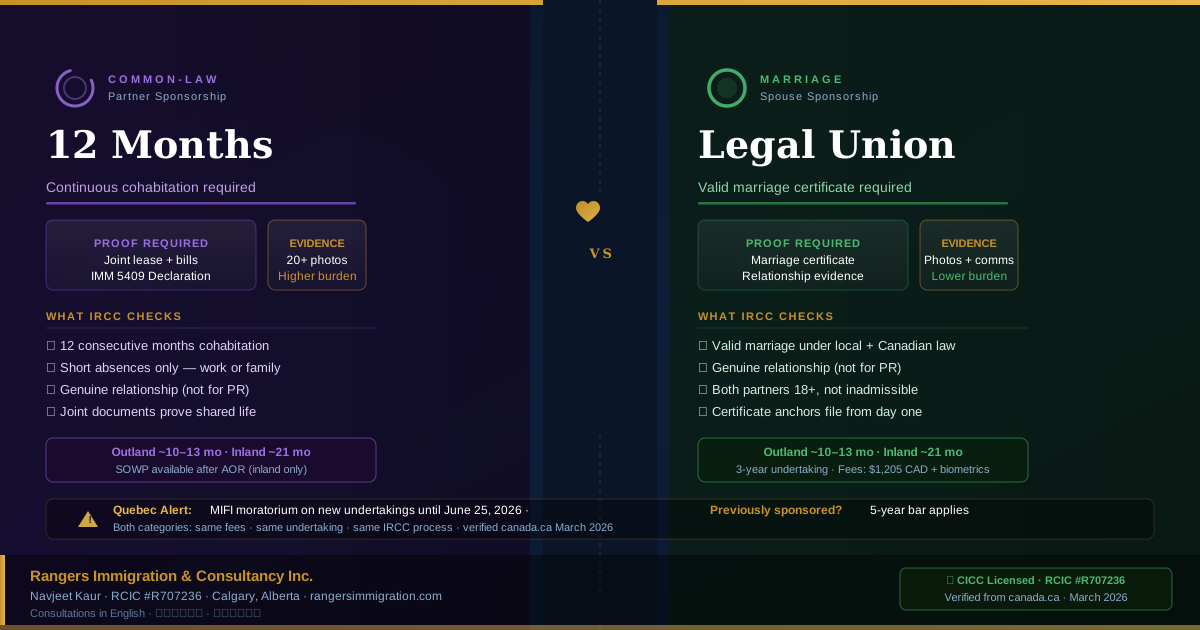
Under Canadian immigration law, your spouse is someone who is legally married to you. The marriage must be valid under the law of the country where it took place and recognized under Canadian law. Your spouse must be at least 18 years old, in a genuine relationship with you, and not inadmissible to Canada. That is it. A valid marriage certificate is the primary evidence. IRCC does not require you to prove cohabitation history, shared finances, or years of living together when a legal marriage exists.
What IRCC Means by “Common-Law Partner”
Your common-law partner is someone who is not legally married to you but has lived with you in a conjugal relationship for at least 12 consecutive months. Specifically, IRCC requires:
- You have lived together continuously for 1 full year
- Any time spent apart was short and temporary — for example, for work travel or family obligations
- The relationship is genuine, not entered into primarily for immigration purposes
- Your partner is at least 18 years old and not inadmissible to Canada
If either partner ends the relationship, IRCC considers it over — regardless of how long you lived together before. There is no marriage certificate to anchor the file. As a result, IRCC expects extensive documentation to prove both the cohabitation timeline and the genuineness of the relationship.
What IRCC Means by “Conjugal Partner”
The conjugal partner is the most misunderstood category. It applies only when marriage and cohabitation have both been impossible due to serious barriers — legal restrictions, immigration constraints, safety concerns, or other significant obstacles. Furthermore, your conjugal partner must live outside Canada. IRCC does not accept conjugal sponsorship simply because a couple prefers not to marry or has not had the opportunity to live together yet. If the only barrier is preference or convenience, IRCC will refuse the application. Consequently, conjugal sponsorship is rare and should only be pursued when a licensed RCIC confirms it is genuinely the correct category.
The Proof Gap — Why Common-Law Applications Require More Evidence
This is the part most comparison guides skip. Both sponsorship categories follow the same IRCC process and the same fee structure. However, the evidence burden for common-law applications is significantly higher, and that gap is where most refusals happen.
Married Sponsors
A valid marriage certificate confirms the legal relationship. IRCC still requires proof of a genuine relationship — photographs, communication records, evidence of shared life — but the certificate anchors the file. An officer reviewing a married sponsorship application has a legal document as a starting point.
To know more in detail: inland vs outland sponsorship 2026
Common-Law Sponsors
IRCC has no equivalent single document for common-law relationships. As a result, common-law applications must prove two separate things: that you actually lived together for 12 consecutive months, and that the relationship is genuine. IRCC requires at least two of the following documents proving cohabitation at the time of application:
- Joint lease agreement or mortgage documents showing both names
- Joint utility bills at the same address (gas, electricity, internet)
- Joint bank account or credit card statements
- Official documents showing both partners at the same address — pay stubs, tax returns, driver’s licences
- IMM 5409 — Statutory Declaration of Common-Law Union, signed by both partners
In addition to cohabitation proof, IRCC expects supporting relationship evidence — up to 20 photographs with descriptions, communication records, and letters from friends or family confirming the relationship.
The practical consequence: A weak evidence package is the most common reason common-law sponsorship applications are refused. Unlike a married couple who can point to a single legal document, common-law partners must build a case from multiple sources. If the joint documentation is thin — for example, only one person’s name is on the lease, or bank statements show separate accounts — the officer may question whether 12 months of genuine cohabitation actually occurred.
Common-Law vs Marriage Sponsorship Canada 2026 — Fees, Timeline, and Undertaking
The government fees and undertaking obligations are the same for both categories.
Government Fees (verified March 2026)
| Fee | Amount |
|---|---|
| Sponsorship application fee | $85 CAD |
| Principal applicant processing fee | $545 CAD |
| Right of Permanent Residence Fee (RPRF) | $575 CAD |
| Total | $1,205 CAD |
| Biometrics (per person, where required) | $85 CAD |
Note: IRCC has not announced a fee increase for 2026 as of March. However, IRCC typically reviews fees on a biennial cycle. Always confirm current fees on canada.ca before submitting.
Processing Times — January 2026 IRCC Data
| Application Type | Processing Time |
|---|---|
| Outland (outside Canada) | ~10–13 months |
| Inland (in Canada, outside Quebec) | ~21 months |
| Quebec-destined (outside Quebec moratorium) | File stalled — see below |
Outland applications move faster because they bypass the inland verification steps. Inland applications take longer. However, inland applicants gain an important advantage: after receiving an Acknowledgement of Receipt (AOR), the sponsored partner may apply for a Spousal Open Work Permit — allowing them to work for any employer in Canada while the PR application process is underway. For more on the SOWP process, read our Spousal Open Work Permit 2026 Complete Guide.
The Undertaking — What the Sponsor Commits To
Both married and common-law sponsors must sign a 3-year undertaking when their partner becomes a permanent resident. This undertaking is a legally binding financial commitment. It means the sponsor agrees to support the sponsored person for 3 years from the day they receive PR — even if the relationship ends, even if the couple divorces or separates, and even if the sponsored person receives social assistance during that period. This obligation does not disappear if the relationship breaks down.
The Quebec Moratorium — A Critical 2026 Update
If either the sponsor or the sponsored person is destined to live in Quebec, this section applies directly to your situation.
As of July 9, 2025, Quebec’s Ministère de l’Immigration, de la Francization et de l’Intégration (MIFI) paused all new undertaking applications for spouses, common-law partners, conjugal partners, and dependent children 18 and older. The moratorium runs until June 25, 2026.
Here is what that means in practice:
IRCC continues to accept and process the federal portion of the sponsorship application. Therefore, you can still submit your application to IRCC, and IRCC will conduct its completeness check and assess sponsor eligibility. However, IRCC cannot approve the permanent residence application until MIFI provides an undertaking. Files destined for Quebec are consequently sitting in inventory — processed federally, but stalled provincially.
Important: Do not submit your undertaking application to Quebec before IRCC tells you to do so. IRCC will send a notification when it is time. Submitting too early causes further delays.
If you are a sponsor currently living in Quebec and this moratorium affects your situation, a consultation with a licensed RCIC is strongly recommended before submitting anything. The file strategy — including timing, documentation, and whether any exceptions apply — matters significantly.
Sponsor Eligibility — Who Cannot Sponsor
Both married and common-law sponsors must meet the same IRCC eligibility requirements. Regardless of relationship category, you cannot sponsor if:
- You are under 18 years old
- You are not a Canadian citizen or permanent resident
- You are receiving social assistance (except for disability reasons)
- You are currently in bankruptcy proceedings
- You are under a removal order
- You have been convicted of certain offences, including domestic violence, sexual offences, or offences causing bodily harm
- You are currently sponsoring another person, and that undertaking is still active
- You were sponsored as a spouse or partner within the past 5 years
That last point catches many people off guard. If you arrived in Canada as a sponsored partner and fewer than 5 years have passed since you received PR, you cannot sponsor a new partner — even if your previous relationship has ended and a new genuine relationship has begun. As a result, it is essential to verify your own eligibility before investing time and money in an application.
Common-Law vs Marriage Sponsorship Canada 2026 — Which Fits Your Situation
You are legally married
Apply as a spouse. Your marriage certificate anchors the file. Focus your evidence package on proving the relationship is genuine — photographs, communication records, proof of shared life, and a clear relationship history. A well-organized, complete application with strong evidence of genuineness moves predictably.
You have lived together for 12+ consecutive months, but are not married
Apply as a common-law partner. Build your evidence package carefully. Joint documentation — lease, bills, bank statements — is the foundation. Add the IMM 5409 Statutory Declaration, photographs, and supporting letters. The stronger and more consistent your cohabitation paper trail, the less likely you are to receive a request for additional documents. If your joint documentation is thin for any period of the 12 months — for example, if one partner was on a work assignment abroad — document that period explicitly and explain it.
You have been in a relationship for over a year, but have never lived together
Consider carefully whether you meet any recognized category. If you are not married, have not cohabited for 12 consecutive months, and the reason is preference or circumstance rather than a genuine legal or safety barrier, you likely do not yet meet the threshold for any IRCC sponsorship category. The most common mistake couples in this situation make is applying as conjugal partners when the facts do not support it. An application that is refused on category grounds costs you the fees and sets back your timeline significantly. In this case, consult an RCIC before submitting anything.
Your partner is already in Canada on a temporary permit
Timeline matters. If your partner is on a work permit or study permit that is expiring, the choice between inland and outland has real consequences. Inland processing takes approximately 21 months; however, your partner can apply for a Spousal Open Work Permit after AOR and continue working legally. Outland processing takes approximately 10–13 months, but your partner must maintain a valid status to remain in Canada during processing or may need to leave. An RCIC can map your permit expiry against the processing timeline and advise which route protects your partner’s status.
Why a Calgary RCIC Matters for Spousal Sponsorship
Spousal and common-law sponsorship files are not technically complex the way provincial nominee applications are. However, they are evidence-intensive, and the consequences of getting the evidence wrong are significant.
A licensed RCIC helps you in three specific ways:
First, category confirmation. Choosing the wrong category — most often applying as conjugal when you should be common-law, or vice versa — results in refusal. An RCIC reviews your specific facts against IRCC’s legal definitions before you submit anything.
Second, evidence architecture. The difference between a smooth common-law application and one that receives a request for additional documents is almost always the quality and organization of the evidence package. An RCIC builds the documentation structure around the cohabitation timeline, identifies gaps, and fills them before submission.
Third, SOWP timing. For inland applicants, the Spousal Open Work Permit application must be submitted correctly and at the right stage. An RCIC who regularly prepares spousal files knows exactly when and how to submit the SOWP so your partner can start working as quickly as possible.
Book a Spousal Sponsorship Consultation
If you are comparing common-law vs marriage sponsorship Canada 2026 and trying to understand which category fits your situation, what your evidence package needs to include, and how to protect your partner’s status during the application process, start with a consultation.
At Rangers Immigration, I review your relationship timeline, confirm the correct IRCC category, assess your current documentation, calculate the evidence gaps, and give you a clear picture of your timeline before you commit to the process. A consultation now prevents a refusal later.
Rangers Immigration & Consultancy Inc. Navjeet Kaur | RCIC #R707236 Calgary, Alberta | Virtual & In-Person Consultations Available 📞 +1 587 221 1000 | rangersimmigration.com Consultations in English, ਪੰਜਾਬੀ & हिन्दी
Book a Spousal Sponsorship Consultation →
This article is for general informational purposes only. All requirements are verified from canada.ca and IRCC data as of March 2026. Processing times, fees, and program rules are subject to change. Reading this article does not create a consultant-client relationship with Rangers Immigration & Consultancy Inc. or Navjeet Kaur. Always verify current requirements on canada.ca or consult a licensed RCIC before submitting any application.