
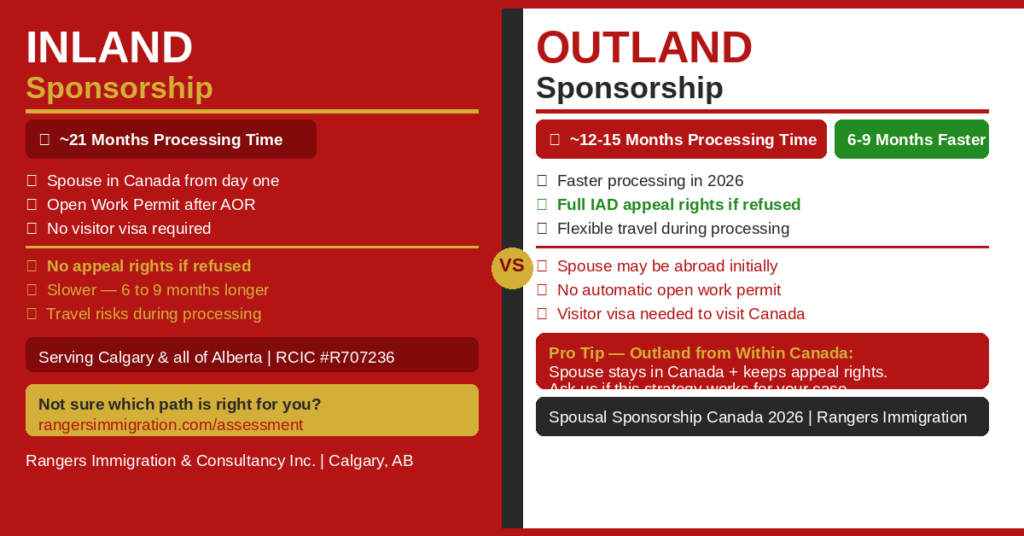
Inland vs. Outland Spousal Sponsorship Canada 2026 — Which Is Faster?
By Navjeet Kaur, RCIC #R707236 | Rangers Immigration & Consultancy Inc., Calgary AB Last Updated: March 2026 | Processing times verified from IRCC’s January 2026 update
If you are comparing inland vs outland spousal sponsorship in Canada 2026, you are facing one of the most consequential decisions in your entire immigration journey. Most couples choose based on incomplete information — and it costs them months of waiting, or worse, the right to appeal if something goes wrong.
This guide gives you the verified, honest comparison of inland vs outland spousal sponsorship Canada 2026 — including current processing times, work permit options, travel rules, sponsor qualifications, and the critical difference most people do not discover until it is too late. Processing times referenced here are from IRCC’s January 2026 official update. Always verify the latest figures at canada.ca before submitting your application.
What Is the Difference Between Inland and Outland Spousal Sponsorship?
Both pathways lead to the same destination — your spouse becomes a Canadian permanent resident. The difference is in how you get there, how long it takes, what your spouse can do while waiting, and what happens if IRCC refuses your application.
Inland Sponsorship: Your spouse is physically in Canada — on a work permit, study permit, visitor visa, or even without status under a specific public policy — and you apply together while living in Canada. Processing happens through IRCC’s Canadian case processing centres.
Outland Sponsorship: Your spouse lives outside Canada, or is in Canada but chooses to have their application processed through the visa office serving their home country. Processing happens through IRCC’s overseas visa offices.
Inland vs Outland Spousal Sponsorship 2026 — Which Is Faster?
This is the question every couple asks first. Here are the verified figures based on IRCC’s processing time tool as of January 2026. Processing times change frequently — always check the current estimate using IRCC’s official processing time tool before planning your timeline.
Inland Sponsorship: Approximately 21 months outside Quebec as of January 2026.
Outland Sponsorship: Approximately 12 to 15 months, depending on the visa office serving your spouse’s country of residence.
Quebec inland sponsorship: 25 to 34 months — and critically, Quebec’s immigration ministry (MIFI) has reached its intake cap and is not accepting new undertaking applications until June 25, 2026. If you live in Quebec, your situation is significantly more complex and requires immediate professional advice.
The bottom line on timing: Outland is currently faster than inland by 6 to 9 months for most applicants outside Quebec. This is the opposite of what many people assume, and it surprises almost every client I sit down with.
Practitioner Insight: In the past year, I have seen inland files with complete, well-organized applications still sitting at 18 to 22 months before any movement. The delay is systemic — not application-specific. For couples where work authorization is not the primary concern, outland processing through certain visa offices has been consistently more predictable.
Can Your Spouse Come to Canada While Waiting? — The Visitor Visa Strategy
This is the question I hear from almost every couple I work with, and the answer often surprises them.
If you applied Inland: Your spouse is already in Canada. They can stay in Canada throughout the process, provided they maintain a valid temporary status — by extending their existing permit or applying to restore status if needed. Read more about maintaining status in our Spousal Open Work Permit guide.
If you applied for Outland, your spouse can apply for a Temporary Resident Visa (Visitor Visa) to visit Canada while the sponsorship application is processing. In 2026, spousal visitor visa applications benefit from what is legally known as Dual Intent — Section 22(2) of the Immigration and Refugee Protection Act explicitly recognizes that a person can intend to stay temporarily while also having a pending permanent residence application.
Visitor visa processing times vary significantly by country and application volume — always check the current estimate using IRCC’s processing time tool before planning your spouse’s visit. Approval rates also vary by country of citizenship and individual circumstances. Your spouse’s visitor visa application must be assessed on its own merits — having an active sponsorship application does not automatically guarantee approval.
If your spouse’s country of residence is one with historically higher visitor visa refusal rates, the visitor visa strategy needs to be carefully planned and professionally prepared. This is an area where the difference between a self-prepared and professionally prepared application is often the difference between approval and refusal.
Can Your Spouse Work in Canada While Waiting?
This is where inland vs outland spousal sponsorship differs most significantly — and for many Alberta families, this single factor determines which path makes sense.
Inland Sponsorship — Open Work Permit Available
After IRCC receives your inland sponsorship application and issues an Acknowledgement of Receipt (AOR), your spouse can apply for a Spousal Open Work Permit (SOWP). This allows them to work for any employer in Canada while waiting for permanent residence.
The AOR typically arrives within a few weeks of IRCC receiving a complete application. After receiving the AOR, the SOWP application takes approximately 4 to 8 months to process currently.
This means your spouse can be working in Canada legally well before the PR decision arrives, which, for inland applications, is currently around 21 months.
Outland Sponsorship — No Automatic Work Authorization
If your spouse applies outland from outside Canada, they generally cannot work in Canada until their permanent residence is approved — unless they qualify for a work permit through a separate program, such as SOWP, through your work permit eligibility, or through an employer-specific job offer.
If your spouse is already in Canada on a work permit and you choose to apply outland, they can continue working on their existing permit while the outland application processes — but they do not receive a new open work permit through the sponsorship process itself.
The Most Critical Difference — Appeal Rights on Refusal
This is the factor most couples do not know about until it is too late.
Outland Sponsorship — Full Appeal Rights
If IRCC refuses your outland application, you have the right to appeal the decision to the Immigration Appeal Division (IAD). The IAD can review both the legal correctness of the decision and whether there are humanitarian and compassionate grounds to approve the application despite the refusal.
Inland Sponsorship — No Right of Appeal
If IRCC refuses your inland sponsorship application, you have no right of appeal to the IAD. Your only options are to reapply from scratch or apply for judicial review in the Federal Court — a much more expensive and limited process that only reviews whether the officer made a legal error, not whether the decision was the right one on the facts.
If your case has any complexity — previous immigration issues, limited relationship documentation, gaps in your history together, or any red flags — inland sponsorship carries significantly higher risk than outland.
Government Fees — Inland and Outland Are the Same
As of March 2026, government fees for spousal sponsorship are identical regardless of which stream you choose:
- Sponsorship fee: $85
- Principal applicant processing fee: $545
- Right of Permanent Residence Fee (RPRF): $575
- Subtotal: $1,205 CAD
- Biometrics: $85 if required (most applicants)
- Total with biometrics: $1,290 CAD
Always verify the current fee amounts at canada.ca’s official fee list before submitting — IRCC adjusts fees periodically under the Service Fees Act.
Inland vs Outland — Quick Comparison Table
| Inland | Outland | |
|---|---|---|
| Where the spouse must be | In Canada | Anywhere |
| 2026 processing time | ~21 months | ~12-15 months |
| Open work permit | Yes — after AOR | No (through sponsorship) |
| Appeal rights if refused | No | Yes — full IAD appeal |
| Travel during the process | Limited | Flexible |
| Spouse can visit Canada | Already here | Visitor visa available |
| Quebec applicants | 25-34 months/moratorium until June 2026 | Also affected by the Quebec moratorium |
Reading this table, one pattern is clear: outland sponsorship offers faster processing, preserved appeal rights, and greater flexibility — at the cost of your spouse not being physically present in Canada from day one. Inland sponsorship keeps your family together immediately and provides a path to work authorization, but comes with longer processing and no appeal safety net. Neither is universally better — the right choice depends entirely on your specific situation.
Which Should You Choose? — The Decision Framework
Choose Outland if:
- Your spouse lives outside Canada, and you want faster overall processing
- If your case has any complexity, red flags, or previous refusals, you need the appeal rights
- Your spouse can visit Canada on a visitor visa during processing
- You or your spouse may need to travel internationally during the process
- You want the security of a full IAD appeal as a safety net
Choose Inland if:
- Your spouse is already in Canada on a valid temporary status
- Your spouse needs to work in Canada immediately and cannot qualify for SOWP through your work permit
- Your relationship evidence is very strong with no complications
- You are comfortable with no appeal rights because your case is genuinely straightforward
The Outland-from-Within-Canada Strategy:
If your spouse is already in Canada, you can still apply outland. IRCC processes the application through the visa office of your spouse’s home country while your spouse remains in Canada on maintained status or their current valid permit. This gives you potentially faster overseas processing AND preserves your full appeal rights — with your spouse physically in Canada throughout. This strategy is not right for everyone, but for complex cases, it is often the most strategic option available.
Can You Leave Canada After Applying for Inland Sponsorship?
This is one of the most common questions I get — and the answer is more nuanced than most people realize.
The short answer: Yes, you can leave Canada. But there are serious risks you must understand first.
No rule forbids either the sponsor or the sponsored person from leaving Canada after submitting an inland application. Short trips for vacation, family visits, or business are generally acceptable.
However, three critical warnings apply:
Warning 1 — Implied Status and Travel Do Not Mix: If your spouse is in Canada on implied or maintained status — meaning their work permit or visitor status has expired and they are waiting for a decision on an extension — leaving Canada while on implied status immediately cancels that implied status. When they return, they re-enter as a visitor only and will not be authorized to work, regardless of how long their work permit application has been in process. This can take months to resolve.
Warning 2 — Frequent or Extended Absences Risk Refusal: Inland sponsorship requires the applicant to genuinely reside in Canada with their sponsor throughout processing. If IRCC determines — based on travel history — that the applicant was not actually residing in Canada, the application can be refused.
Warning 3 — Re-Entry Is Never Guaranteed: The PR applicant is not a Canadian citizen. CBSA is not required to re-admit them to Canada. If the applicant is denied entry on return for any reason, their inland application may be deemed abandoned. A new application would need to be submitted from outside Canada as an outland application, losing all the time already invested.
If your spouse needs to travel at any point during the processing period, have a licensed RCIC assess your specific situation before that trip.
Who Can Sponsor? — Qualifications and Disqualifications
Not every Canadian citizen or permanent resident can sponsor a spouse. Being disqualified as a sponsor is one of the most overlooked issues in spousal sponsorship applications.
You ARE eligible to sponsor if you:
- Are you a Canadian citizen or permanent resident living in Canada, or a Canadian citizen abroad who commits to living in Canada when your spouse becomes a PR
- Are at least 18 years old at the time of application
- Are not currently receiving social assistance (other than for disability)
- Are not bankrupt
- Are not currently in prison or detention
- Are not under a removal order (permanent residents only)
- Have not been sponsored for PR as a spouse yourself within the last 5 years
You are NOT eligible to sponsor if you:
- Were convicted of a violent criminal offence, sexual offence, or offence causing bodily harm — particularly against a family member or intimate partner
- Currently have a removal order in effect against you (for PRs)
- Are in default on a previous immigration undertaking — meaning you sponsored someone before, and they received social assistance
- Are you a permanent resident living outside Canada
- Were sponsored as a spouse yourself and obtained PR less than 5 years ago
No Minimum Income Requirement for Spousal Sponsorship: Unlike parent and grandparent sponsorship, there is no minimum income threshold required to sponsor a spouse or common-law partner. You do not need to prove you earn a certain salary. This is a common misconception.
Criminal Record — The Most Overlooked Disqualifier: A criminal record does not automatically disqualify you from sponsoring — but certain offences do. If you have any criminal history — even a charge that was withdrawn, stayed, or resulted in a discharge — disclose it and get professional advice before submitting. Attempting to hide a criminal record constitutes misrepresentation, which carries a 5-year ban and potentially permanent consequences.
How Long Before You Get the AOR?
After submitting a complete application, IRCC typically issues an Acknowledgement of Receipt (AOR) within a few weeks for online applications. The AOR confirms IRCC has received your application and has started processing. For inland applicants, the AOR is the trigger for applying for the Spousal Open Work Permit — so submitting a complete, well-organized application from the start is critical to getting your AOR as quickly as possible.
The Strategy That Changes the Timeline
For many Alberta couples I work with, the fastest path to having your spouse in Canada and working is a combination approach: apply outland for faster overseas processing and preserved appeal rights, while simultaneously applying for a Spousal Open Work Permit (SOWP) through your work permit eligibility. These two applications can run simultaneously and complement each other.
This dual-track approach is only possible when you understand both pathways fully before committing to one — and when your SOWP eligibility under the Alberta work permit streams is confirmed in advance.
Inland vs Outland Checklist — Before You Decide
Check your situation:
- Is your spouse currently in Canada or outside Canada?
- Does your spouse have a valid temporary status in Canada right now?
- Does your spouse need to work in Canada during the process?
- Does your case have any complexity — previous refusals, immigration violations, or limited documentation?
- Will you or your spouse need to travel internationally during processing?
- Do you live in Quebec?
Red flags that require professional review before choosing:
- Previous visa refusal for your spouse
- Spouse is currently without a valid status in Canada
- Common-law relationship with documentation gaps
- Sponsor has previously been refused as a sponsor
- The relationship began online with limited in-person history
- Any criminal history on the sponsor’s record
Frequently Asked Questions — Inland vs Outland Spousal Sponsorship Canada 2026
Is inland sponsorship faster than outland in 2026? No. As of January 2026, inland sponsorship takes approximately 21 months while outland sponsorship takes approximately 12 to 15 months, depending on the visa office. Outland is currently faster by 6 to 9 months for most applicants outside Quebec.
Can I apply for outland while my spouse is already living in Canada? Yes. This is called the outland-from-within-Canada strategy. Your spouse remains in Canada on their current status while IRCC processes the application through the overseas visa office serving their home country. This preserves full appeal rights and may offer faster processing, while keeping your family together.
Can my spouse work while waiting for spousal sponsorship PR approval? It depends on which stream you choose. With inland sponsorship, your spouse can apply for a Spousal Open Work Permit (SOWP) after the AOR is issued. With outland sponsorship, your spouse cannot receive an open work permit through the sponsorship process, though they may qualify separately through your eligible work permit.
What happens if an inland spousal sponsorship is refused? If your inland application is refused, you have no right of appeal to the Immigration Appeal Division (IAD). Your only options are to reapply from scratch or apply for judicial review in the Federal Court, which is significantly more expensive and limited in scope. This is why cases with any complexity should strongly consider outland sponsorship to preserve full appeal rights.
Is a visitor visa approval easier when spousal sponsorship is already filed? Having an active sponsorship application on file supports a Dual Intent argument under Section 22(2) of IRPA, which can strengthen a visitor visa application. However, it does not guarantee approval. Visitor visa decisions are made independently, and approval rates vary significantly by country of citizenship and individual circumstances.
How long does it take to get the AOR for inland sponsorship? For complete online applications, IRCC typically issues the AOR within a few weeks of receiving the submission. The AOR is important because it triggers your spouse’s eligibility to apply for a Spousal Open Work Permit.
Can I leave Canada after submitting an inland sponsorship application? Short trips are generally acceptable, but leaving Canada carries serious risks — particularly if your spouse is on implied status, as leaving immediately cancels that status. Extended or frequent absences can also raise residency concerns with IRCC. Always consult a licensed RCIC before any travel during inland sponsorship processing.
Ready to Find Out Which Path Is Right for You?
Choosing between inland and outland sponsorship is one of the most consequential decisions in your immigration journey. Getting it wrong can cost months of additional waiting — or your right to appeal if something goes wrong.
Complete our free immigration assessment at rangersimmigration.com, and I will personally review your situation, recommend the right pathway, and tell you exactly what your realistic timeline looks like.
Rangers Immigration & Consultancy Inc. Navjeet Kaur | RCIC #R707236 Calgary, Alberta | Virtual & In-Person Consultations Available Across Canada Consultations available in English, ਪੰਜਾਬੀ & हिन्दी 📞 +1 587 221 1000
This article is for general informational purposes only and reflects IRCC policy and processing times as of March 2026. Processing times change frequently — this article will be updated quarterly. Always verify current times at canada.ca. Reading this article does not create a consultant-client relationship.