
Stuck at 400 CRS? Why an Alberta PNP Pivot Is Your Best Plan B in 2026
By Navjeet Kaur, RCIC #R707236 | Rangers Immigration & Consultancy Inc., Calgary AB Last Updated: March 2026 | Data sourced from IRCC and Alberta.ca official sources
If you are working in Alberta on a work permit, watching Express Entry draw after draw pass you by with CRS cutoffs you cannot reach, this guide is written specifically for you. You are not alone — and your situation is not hopeless. It just requires a different strategy than the one you started with.
In 2026, the Express Entry pool for Alberta PNP and CRS score strategy has changed fundamentally. The candidates who are getting PR are not always the ones with the highest scores. They are the ones who understand how the new system works — and how Alberta’s provincial nomination program changes the entire equation.
Why Your CRS Score Feels Stuck — The 2026 Reality
The Express Entry system of 2026 is not the same system it was two years ago. Canada has moved from a simple highest-score-wins model to a targeted, category-based selection system designed to fill specific labour market gaps. This shift has created a paradox that frustrates thousands of skilled workers in Alberta every month:
You can have a perfectly competitive CRS score of 490 or 510 — and still watch draw after draw issue invitations to candidates in healthcare, French speakers, or trades workers at cutoffs you cannot match.
Here is what the current data shows. According to IRCC’s official Express Entry draw history, as of February 2, 2026, the Express Entry pool contains 238,920 profiles. The highest concentration of candidates is now sitting between 350 and 400 CRS points — meaning you are competing with tens of thousands of equally-scored candidates for every general draw. Meanwhile, targeted category-based draws are consistently going to candidates with lower absolute scores but stronger sector alignment.
In February 2026 alone, IRCC issued invitations across multiple draw types:
- A Canadian Experience Class (CEC) draw on February 17 issued 6,000 invitations at a CRS cutoff of 508
- A Healthcare and Social Services draw on February 20 issued 4,000 invitations at a CRS cutoff of 467
- A French language proficiency draw issued 8,500 invitations at a CRS cutoff of just 400
The pattern is clear: if you are not in a priority category and your score is not above 510, you are in a waiting game with no guaranteed end date. This is exactly why the Alberta PNP pivot is not just a backup plan — for many workers in Alberta right now, it is the primary strategy.
Practitioner Insight: In my Calgary practice, I am seeing more and more clients who have been sitting in the Express Entry pool for 12 to 18 months with scores between 460 and 510, watching every draw miss them. For most of these clients, the AAIP pathway — particularly the Alberta Opportunity Stream for those already working in the province — has been the most reliable route to a nomination and ultimately to PR.
What Is the Alberta PNP and How Does It Change Your CRS Math?
The Alberta Advantage Immigration Program (AAIP) is Alberta’s Provincial Nominee Program — a joint federal-provincial program that allows Alberta to nominate candidates for Canadian permanent residence based on the province’s specific labour market needs.
Alberta PNP CRS 400 2026 — Why This Strategy Works When Express Entry Does Not
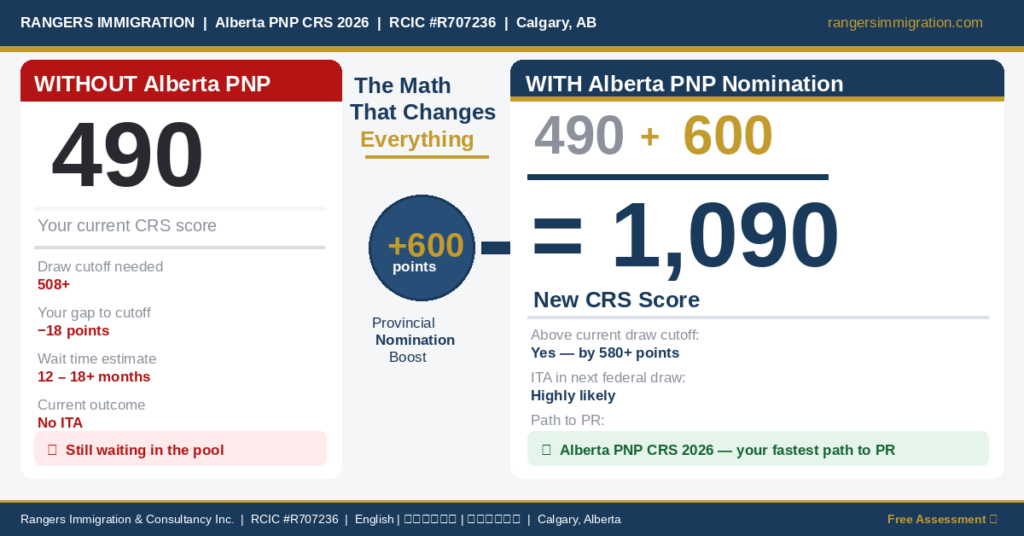
A provincial nomination adds 600 points to your CRS score.
600 points. If your current score is 490, a nomination takes you to 1,090 — far above any current Express Entry cutoff. Your federal Invitation to Apply in a subsequent draw after your nomination becomes significantly more likely — in most cases, the next draw will reach your new score.
The Key Insight Most Candidates Miss — Alberta Does Not Care About Your CRS Score
This is the insight that changes everything for many clients I work with in Alberta.
Alberta’s AAIP has a minimum CRS requirement of 300 points for its Express Entry stream. That is not a typo. Three hundred points. Meanwhile, federal Express Entry draws are cutting off at 467 to 508.
Why? Alberta does not select candidates based on their federal CRS score. Alberta uses its own provincial points grid that evaluates your occupation, your connection to Alberta, your work experience in the province, and your employer. A software developer in Calgary with a CRS of 380 and an Alberta tech employer is far more likely to receive an AAIP invitation than a general manager with a CRS of 510 and no Alberta job offer.
This sector-driven approach means your path to a nomination depends on what you do — not what your score is. And for workers already employed in Alberta in a priority sector, this is significant good news.
Alberta’s 2026 Priority Sectors — Where AAIP Is Actively Recruiting
According to official Alberta.ca guidance, AAIP’s primary priority sectors for 2026 are:
- Healthcare and medical occupations
- Technology (software, IT, engineering)
- Construction trades
- Manufacturing (added as a new priority in January 2026)
- Aviation
- Agriculture
- Communities designated under the Rural Renewal Stream
According to Alberta’s official AAIP draw information page, in February 2026 alone, Alberta conducted seven separate AAIP draws issuing a total of 1,376 invitations — including 915 invitations through the Alberta Opportunity Stream and 148 through the Accelerated Tech Pathway. The pace of Alberta draws is consistent and sector-targeted.
If your occupation falls within any of these sectors, you are in AAIP’s active recruitment zone right now.
Your Alberta PNP Pivot Strategy — Which Stream Fits You?
Your strategy depends on your specific situation. Here are the four pathways most relevant to Express Entry candidates already working in Alberta:
Option 1 — Alberta Opportunity Stream (AOS)
Best for: Workers already employed full-time in Alberta across most TEER levels — including TEER 4 and 5, which are excluded from federal Express Entry draws.
The AOS is Alberta’s most accessible worker stream. It accepts candidates across a wide range of occupations and does not require an active Express Entry profile. If you are already working in Alberta with a valid work permit, this stream evaluates you on Alberta’s own points grid — not your federal CRS score.
Critical requirement: You must hold a valid work permit at the time of both application and AAIP assessment. Maintained status does not qualify. If your permit is expiring, extend it before applying.
Option 2 — Alberta Express Entry Stream (AEES)
Best for: Workers in priority sectors with an active Express Entry profile and a minimum CRS of 300.
This is the stream that connects directly to your federal Express Entry profile and delivers the 600-point nomination boost. AAIP sends you a Notification of Interest (NOI), you apply, and upon nomination, your CRS goes to 1,090+.
The key here: Alberta is headhunting for sector alignment, not CRS maximums. A healthcare worker in Calgary with CRS 350 and an Alberta hospital employer is a stronger AAIP candidate than a generic professional with CRS 400 and no provincial connection.
Option 3 — Accelerated Tech Pathway
Best for: Technology professionals employed by an Alberta-based tech employer.
This dedicated pathway within the Alberta Express Entry Stream has seen consistent draw activity in 2026. If you work in software development, IT, data, or engineering in Alberta’s tech sector, this pathway should be your first assessment point. The January 29, 2026 draw issued 148 invitations specifically through this pathway.
Your employer must qualify under AAIP’s eligible NAICS codes for the tech industry, and you must have an active Express Entry profile with a minimum CRS of 300.
Option 4 — Dedicated Healthcare Pathway
Best for: Healthcare professionals employed in an eligible healthcare occupation in Alberta.
Healthcare has been Alberta’s most consistent draw priority throughout 2025 and into 2026. If you are a nurse, physician, allied health professional, or healthcare support worker with an Alberta employer, this pathway should be assessed immediately. Both Express Entry and non-Express Entry options exist under this pathway, meaning even candidates without a federal Express Entry profile may qualify.
The Two-Track Strategy — AAIP and Express Entry Running Simultaneously
This is the approach I recommend to most of my Alberta clients whose CRS score sits between 450 and 520.
Do not abandon your federal Express Entry profile. Keep it active, keep it updated, and stay aligned with any category-based draw that matches your occupation. At the same time, submit your AAIP Expression of Interest immediately. These two processes run simultaneously and do not interfere with each other.
Here is why this matters: if a general federal draw reaches your score before your AAIP nomination comes through, you get your ITA through Express Entry. If AAIP nominates you first, your CRS jumps to 1,090+, and your ITA arrives in the very next federal draw. Either way, you win. Running both simultaneously means you have two separate paths to the same destination — and you take whichever one opens first.
The biggest mistake I see is candidates waiting for the federal general draw alone — sometimes for 18 months or longer — while their PGWP countdown is running and an AAIP pathway they qualified for the entire time goes unused. Do not let that be your story.
What Happens to Your PGWP While You Wait?
This is the most urgent concern I hear from clients in Alberta — and it is legitimate.
If your Post-Graduation Work Permit (PGWP) expires while you are waiting for either a federal draw or an AAIP nomination, your eligibility for both pathways changes significantly. A valid work permit is required for the Alberta Opportunity Stream at time of application and assessment. If your PGWP expires, maintained status does not protect you.
The strategic response depends on your specific timeline and occupation. In some situations, an employer-specific work permit extension, an LMIA-backed work permit, or a bridging open work permit may preserve your ability to continue working and maintain AAIP eligibility. Do not wait until your permit is about to expire to assess your options — the planning needs to happen 6 to 12 months before expiry.
CRS Score Optimization — What Can Actually Move Your Number in 2026
While the AAIP pivot is the most powerful strategy for most mid-range CRS candidates, it is also worth understanding which profile improvements can meaningfully move your federal score while you wait.
Actions that actually improve your CRS in 2026:
First — French language proficiency. This is currently the highest ROI improvement available on the Express Entry market. A February 2026 French language draw issued 8,500 invitations at a CRS cutoff of just 400. If you can achieve CLB 7 or higher in French alongside your English scores, your CRS improvement can be dramatic. Even CLB 5 in French adds meaningful points.
Second — Spousal profile optimization. If you are married, your spouse’s language scores and education credentials contribute to your CRS. If your spouse has not taken a language test, they should. Adding your spouse’s Canadian education credential assessment (ECA) can also add points. In some profiles, switching the principal and secondary applicant designation improves the total score significantly.
Third — Canadian education. If you completed a two-year or longer program at a Canadian institution, those points are already in your profile. If you have partial Canadian credentials that have not been properly claimed, review your profile for accuracy.
Fourth — Job offer points. An LMIA-backed job offer at TEER 0, 1, 2, or 3 adds 50 to 200 CRS points depending on the NOC level. In the current labour market, LMIA approvals in healthcare, construction, and technology in Alberta remain accessible for the right candidates.
Stuck at 400 CRS — The Checklist for Alberta Workers
Use this to assess your position right now:
AAIP Eligibility Check:
- Currently employed full-time in Alberta with a valid work permit
- Occupation falls within a 2026 AAIP priority sector (healthcare, tech, construction, manufacturing, aviation, agriculture)
- Active Express Entry profile with CRS of 300 or higher (for AEES)
- Work permit valid — not on maintained status
- NOC code accurately reflects the current occupation and TEER level
CRS Optimization Check:
- Language scores verified as current (IELTS/CELPIP within 2 years)
- French language test considered or completed
- Spouse’s language test and ECA included in profile if applicable
- Canadian education credentials are properly assessed and claimed
- Job offer points assessed — LMIA viability discussed with the employer
Urgent Action Flags:
- PGWP or work permit expiring within 12 months — immediate planning required
- Profile sitting in pool for 12+ months without an ITA — strategy review needed
- CRS score between 350 and 450 with no category-based draw alignment — AAIP pivot assessment needed
Frequently Asked Questions — Alberta PNP and CRS Score 2026
Can I apply to Alberta PNP if my CRS score is only 350? Yes. For the Alberta Opportunity Stream, there is no federal CRS score requirement at all — Alberta uses its own points grid. For the Alberta Express Entry Stream, the minimum CRS is 300. A CRS of 450 is well above the minimum. What matters is your occupation, your Alberta connection, and your employer.
Does applying to AAIP affect my Express Entry profile? No. You can have an active AAIP Expression of Interest and an active federal Express Entry profile simultaneously. They run completely independently. You take whichever pathway produces a result first.
How long does the AAIP process take from EOI to nomination? AAIP does not publish guaranteed timelines. From EOI submission to receiving a Notification of Interest varies based on draw frequency, your sector, and your provincial points score. From NOI to receiving a nomination certificate typically takes 3 to 6 months if your application is complete and well-prepared.
What happens after I receive an AAIP nomination? Your CRS score increases by 600 points. In the very next Express Entry draw after your nomination is entered into your profile, you will almost certainly receive a federal Invitation to Apply for permanent residence. From ITA to PR application submission, you then have 60 days.
What if my occupation is not in a 2026 AAIP priority sector? You may still qualify through the Alberta Opportunity Stream if you are employed full-time in Alberta with a valid work permit, even in TEER 4 or 5 occupations. However, draw frequency and invitation volumes are lower for non-priority sectors. Have your profile assessed to understand your realistic prospects before investing significant time.
Can my spouse’s Express Entry points help my application? Yes — significantly. In a spousal Express Entry profile, your spouse’s language scores can add up to 20 points, and their Canadian education can add additional points. In some cases, switching which spouse is the principal applicant results in a 20 to 40 point improvement. This assessment takes less than 30 minutes with a licensed RCIC.
Is it worth learning French just for CRS points? In 2026, yes — for the right profile. If your current CRS is between 440 and 490, achieving CLB 7 or higher in French can add 30 to 50 points to your score and open access to French language category draws that have been cutting off at 400. The time investment is typically 3 to 6 months of preparation.
Alberta PNP CRS 400 2026 — The Bottom Line for Alberta Workers
A CRS score of 400 is not a failure. It is not disqualifying. It is simply a signal that the federal Express Entry general draw path alone is not your fastest or most reliable route — and that Alberta’s provincial nomination program, designed specifically for workers already contributing to Alberta’s economy, may be your clearest path to permanent residence right now.
Alberta conducted seven separate draws in February 2026 alone. The province is actively recruiting. Your occupation, your Alberta employer, and your community connection matter more to AAIP than your federal CRS score. If you are already working in this province, you already have the most valuable asset in the AAIP system — you are here, contributing, and exactly the kind of candidate Alberta is trying to retain.
Ready to Find Out If Alberta PNP Is Your Path?
Every profile is different. The right stream, the right timing, and the right preparation strategy depend entirely on your specific occupation, employer, and permit situation.
Contact us at rangersimmigration.com, and I will personally review your Express Entry profile and AAIP eligibility — and tell you exactly which pathway gives you the fastest, most reliable route to permanent residence in Alberta.
Rangers Immigration & Consultancy Inc. Navjeet Kaur | RCIC #R707236 Calgary, Alberta | Virtual & In-Person Consultations Available Across Canada Consultations available in English, ਪੰਜਾਬੀ & हिन्दी 📞 +1 587 221 1000
This article is for general informational purposes only and reflects IRCC and AAIP policy as of March 2026. Express Entry draw cutoffs, CRS scores, and AAIP draw parameters change frequently — this article will be updated quarterly. Always verify current requirements at canada.ca and alberta.ca. Reading this article does not create a consultant-client relationship.