
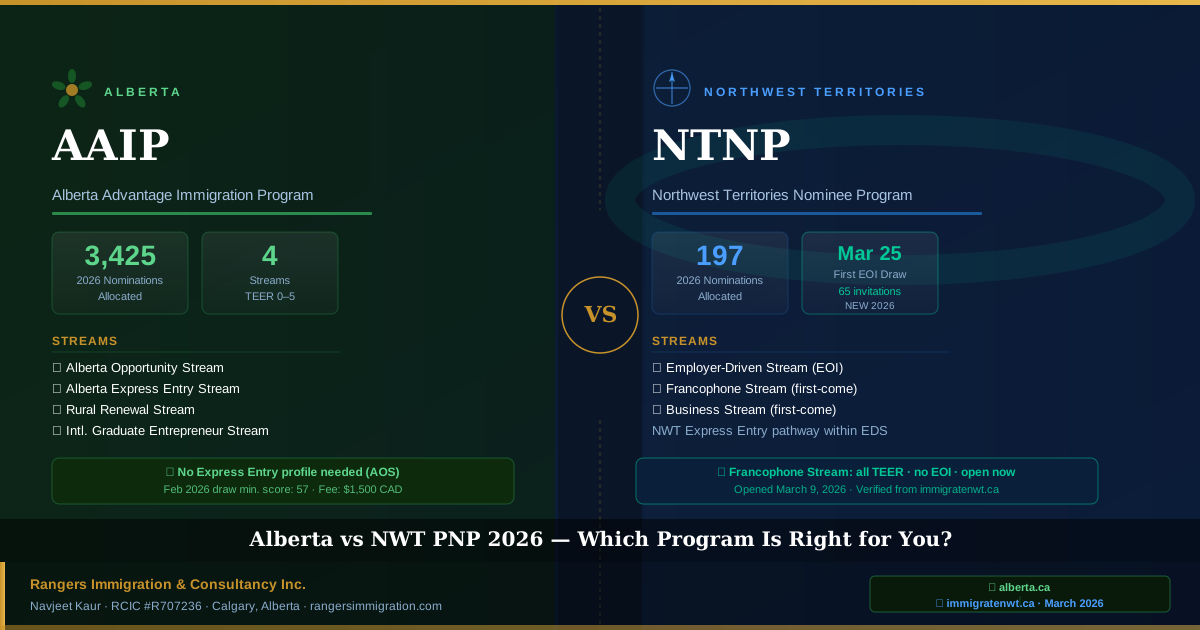
Alberta vs NWT PNP 2026 — Which Provincial Nominee Program Is Right for You?
By Navjeet Kaur, RCIC #R707236 | Rangers Immigration & Consultancy Inc., Calgary AB Last Updated: March 2026 | All facts verified from Alberta Advantage Immigration Program | Alberta.ca and Northwest Territories Nominee Program
The Alberta vs NWT PNP 2026 question comes up constantly — for workers in northern Alberta, for workers currently based in the Northwest Territories, and for anyone with a low CRS score who needs a provincial nomination to make permanent residence happen. Both programs nominate foreign workers for Canadian PR. However, they are built for different situations, and choosing the wrong one based on incomplete information costs months.
This guide compares the Alberta Advantage Immigration Program (AAIP) and the Northwest Territories Nominee Program (NTNP) side by side. Specifically, it covers nomination spaces, stream structures, EOI systems, employer requirements, and the scenarios where one program clearly outperforms the other. All information is verified from alberta.ca and immigratenwt.ca as of March 2026.
Alberta vs NWT PNP 2026 — The Key Numbers First
Before diving into streams and eligibility, look at the numbers. They tell you a great deal about the competitive environment in each program.
| AAIP (Alberta) | NTNP (Northwest Territories) | |
|---|---|---|
| 2026 nomination allocation | 3,425 | 197 |
| Number of streams | 4 | 3 |
| Employer-Driven selection method | EOI draws | EOI draws (new 2026) |
| +600 CRS points on nomination | Yes | Yes |
| Program reopened | Active year-round | March 9, 2026 |
| First 2026 draw (Employer-Driven) | Active throughout 2026 | March 25, 2026 |
The AAIP has more than 17 times the nomination spaces of the NTNP. As a result, more candidates receive nominations through Alberta each year than through any other western Canadian province or territory. However, more spaces also means a much larger and more competitive EOI pool. The NTNP pool is smaller — and in 2026, so is the allocation.
Alberta offers scale. The NWT offers concentration. The right choice depends on where your strongest ties already exist.
Alberta vs NWT PNP 2026 — Stream by Stream
AAIP Streams (Alberta)
The Alberta Advantage Immigration Program has four streams in 2026:
Alberta Opportunity Stream (AOS) — the flagship stream. It is for workers in TEER 0 through 5 occupations who have a qualifying job offer in Alberta. No Express Entry profile is required. The AOS has three work experience pathways: 12 months of Alberta experience, 24 months of Canadian or international experience, and a PGWP pathway. For a complete breakdown of AOS eligibility and the EOI points grid, read our Alberta Opportunity Stream 2026 Complete Guide.
Alberta Express Entry Stream — for workers who already hold an active federal Express Entry profile. This pathway links directly to the federal system. Nomination adds 600 CRS points, which results in an ITA at the next available federal draw.
Rural Renewal Stream — for workers with a job offer in an eligible rural Alberta community. In particular, it supports population growth in smaller communities outside Calgary and Edmonton.
International Graduate Entrepreneur Stream — for recent international graduates of designated Alberta post-secondary institutions who want to establish a business in Alberta.
For a full overview of all four AAIP streams, read our Alberta PNP 2026 Complete Guide.
NTNP Streams (Northwest Territories)
The Northwest Territories Nominee Program has three streams in 2026:
Employer-Driven Stream — the largest and most competitive NTNP stream. It covers three pathways: Skilled Worker (TEER 0–3), Entry Level/Semi-Skilled (TEER 4–5), and NWT Express Entry (TEER 0–3, requires active EE profile). In 2026, this stream uses a brand new EOI system — a significant change from prior years. Employers register first, candidates submit an EOI, and GNWT conducts draws from the ranked pool. The first draw is March 25, 2026.
Francophone Stream — for bilingual French and English workers across all TEER categories (0 through 5). Unlike the Employer-Driven Stream, this stream operates on a first-come, first-served basis and does not use an EOI system. It opened March 9, 2026.
Business Stream — for foreign nationals who want to start, buy, or invest in a business in the NWT. Similarly, it operates first-come, first-served. Investment minimums start at $100,000 CAD outside Yellowknife and $200,000 CAD within Yellowknife.
For a full breakdown of all NTNP streams, eligibility, and the EOI points grid, read our NTNP 2026 Complete Guide.
How the EOI Systems Compare
However, Alberta allows candidates to submit an EOI independently, whereas the NTNP process cannot begin until the employer is registered.
AAIP EOI system — Alberta runs multiple EOI draws throughout the year. The AOS draw in February 2026 had a minimum score of 57 out of 100. Points are distributed between Human Capital (69 points maximum) and Economic factors (31 points maximum). Additionally, candidates can submit an EOI without employer involvement first.
NTNP EOI system (new in 2026) — The NWT system scores candidates on a maximum of 845 points across three categories: Human Capital (375 points total: language 125, work experience 100, education 100, age 50), Connections to NWT Labour Market (340 points), and Adaptability to NWT (130 points). Critically, the employer must register in the NTNP portal before the candidate can submit anything. The first draw invited up to 65 candidates.
The key structural difference: The NTNP EOI system heavily weights whether you are already living and working in the NWT. The Connections to NWT Labour Market category alone carries 340 of 845 possible points. Consequently, a candidate currently working in the NWT on a closed, employer-specific work permit will consistently outscore a candidate applying from outside the territory. The AAIP system, by contrast, weighs human capital and economic factors more evenly — making it more accessible to candidates who have not yet worked in Alberta.
Employer Requirements — A Direct Comparison
Employer eligibility is where many applications fail. Both programs have specific rules. Moreover, these rules differ in ways that matter at the application stage.
AAIP — AOS employer requirements:
- Operating in Alberta for at least 2 full fiscal years
- Minimum gross annual revenue of $400,000 CAD
- Minimum 3 full-time employees based in Alberta
- Wage at or above the Alberta median for the candidate’s NOC code
NTNP — Employer-Driven Stream:
- Valid, full-time, permanent job offer for the candidate in the NWT
- Evidence that the position could not be filled locally or nationally
- The employer must register in the NTNP online portal before the EOI can be submitted
- The employer initiates the process — the candidate cannot start without them
The practical difference: In Alberta, the employer’s financial history and employee count are hard eligibility criteria. Therefore, a small or newer business may disqualify your application before it ever reaches the EOI stage. In the NWT, the threshold is a valid permanent job offer; however, the employer must actively start the process. If your NWT employer is unaware that they need to register first, your EOI simply cannot be submitted.
TEER Coverage — Which Workers Qualify Where
This is one of the most important differences between the two programs. It directly determines whether you are eligible to apply at all.
| TEER Level | AAIP (AOS) | NTNP Employer-Driven | NTNP Francophone |
|---|---|---|---|
| TEER 0 (Management) | ✅ | ✅ Skilled Worker | ✅ |
| TEER 1 (Professional) | ✅ | ✅ Skilled Worker | ✅ |
| TEER 2 (Technical) | ✅ | ✅ Skilled Worker | ✅ |
| TEER 3 (Trades) | ✅ | ✅ Skilled Worker | ✅ |
| TEER 4 (Semi-Skilled) | ✅ | ✅ Entry Level pathway | ✅ |
| TEER 5 (Entry Level) | ✅ | ✅ Entry Level pathway | ✅ |
Both programs cover all TEER levels. However, the requirements differ significantly for lower TEER levels in the NTNP. For TEER 4 and 5 candidates in the Employer-Driven Stream, the 12-month same-employer rule applies — specifically, you must have worked full-time with the nominating NWT employer for 12 consecutive months. In contrast, the AAIP AOS accepts 12 months of Alberta work experience spread across different employers.
The underrated NTNP advantage for bilingual candidates: The Francophone Stream covers TEER 0 through 5 and operates first-come, first-served with no EOI draw. For a French-English bilingual worker in a TEER 4 or 5 occupation with an NWT job offer, this stream may be the fastest nomination route available right now — because it bypasses the draw system entirely.
Alberta vs NWT PNP 2026 — Which Program Fits Your Situation
This is the section most comparison guides skip. They compare programs in the abstract. What actually matters, though, is which program fits your specific situation.
If You Are Working in Alberta
The AAIP is generally the right starting point. First, confirm your employer meets the AOS criteria — 2 full fiscal years of operating history, $400,000 CAD gross revenue, and 3 full-time Alberta employees. If your employer qualifies, the AOS covers all TEER levels and does not require an Express Entry profile. Alternatively, if you already hold an active Express Entry profile in a TEER 0–3 occupation, the Alberta Express Entry Stream is your fastest route — nomination adds 600 CRS points and an ITA follows at the next federal draw.
If You Are Already Working in the NWT
The NTNP Employer-Driven Stream is likely your best option. In particular, the EOI scoring system favours candidates already embedded in the territory. If you hold a closed, employer-specific work permit, work in a designated trades occupation, or work in a small NWT community outside Yellowknife, your Connections to NWT Labour Market score will be strong. Furthermore, if you have worked with the same NWT employer for 12+ consecutive months in a TEER 4 or 5 role, the Entry Level pathway opens up as well. The key first step is getting your employer to register in the NTNP portal — without that, your EOI cannot be submitted.
If You Are Bilingual in French and English
The NTNP Francophone Stream deserves serious consideration. Unlike the Employer-Driven Stream, it operates first-come, first-served basis and covers all TEER categories. As a result, a bilingual candidate with any NWT job offer can apply without waiting for a draw. This is one of the fastest nomination pathways in Canada right now for workers who qualify.
If Neither Program Is Immediately Accessible
Some workers find they do not qualify for either program right away. For instance, your Alberta employer may not yet meet the 2-year operating threshold. Or you may have an NWT job offer, but your employer has not registered yet. In these cases, the better next step is usually to strengthen your CRS score through a language retest or a formal credential assessment. A higher CRS score increases your options across both programs.
Processing and Timeline — What to Expect
Neither program publishes fixed processing timelines. However, the 2026 program structures give a general picture.
AAIP (AOS): Your wait in the EOI pool depends on your score relative to the current pool. The $1,500 AAIP application fee must be paid within 24 hours of submitting the full application — otherwise the application is cancelled. Once nominated, you apply to IRCC for PR. Through Express Entry, federal processing is approximately 6 months. Through the non-EE stream, it is approximately 18 months.
NTNP (Employer-Driven): The program reopened on March 9. The first EOI draw runs March 25, with up to 65 invitations. After an invitation, the employer submits a full application, assessed in order of receipt. After nomination, the same IRCC federal timelines apply — approximately 6 months via Express Entry, 18 months via the non-EE route.
Not Sure Which Program You Qualify For? Start Here.
Choosing between Alberta vs NWT PNP 2026 comes down to where you work, who your employer is, and your Express Entry situation. Both programs changed significantly for 2026. Moreover, both require preparation and timing to be competitive.
Book a free assessment at rangersimmigration.com/assessment. I will review your NOC code, your employer’s eligibility under both programs, your EOI score estimate for each, and give you a clear recommendation on which program to pursue — and when.
Rangers Immigration is based in Calgary, Alberta, and serves clients across Calgary, Airdrie, Red Deer, Edmonton, Lethbridge, Grande Prairie, and rural Alberta communities. In-person consultations are available in Calgary by appointment. Virtual consultations are available across Canada.
Rangers Immigration & Consultancy Inc. Navjeet Kaur | RCIC #R707236 Calgary, Alberta | Virtual & In-Person Consultations Available 📞 +1 587 221 1000 | rangersimmigration.com Consultations in English, ਪੰਜਾਬੀ & हिन्दी
This article is for general informational purposes only. All program requirements are verified from alberta.ca and immigratenwt.ca as of March 2026. Nomination allocations, draw schedules, EOI point grids, and eligibility criteria are subject to change without notice. Reading this article does not create a consultant-client relationship. Always verify current requirements before submitting any application.