
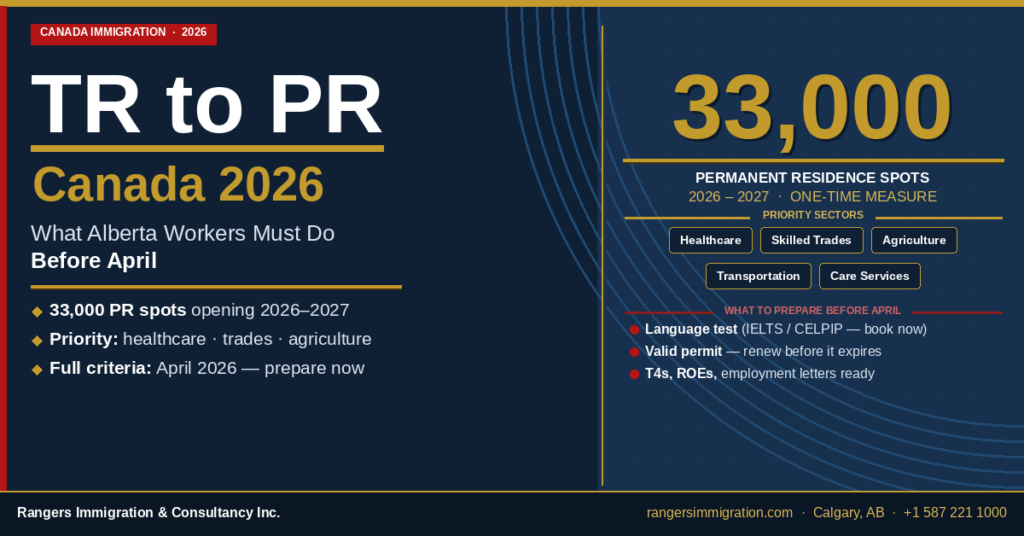
TR to PR Canada 2026 — What Alberta Workers Must Do Before April
On March 6, 2026, Immigration Minister Lena Metlege Diab confirmed that Canada has quietly launched a one-time pathway granting permanent residence to 33,000 temporary foreign workers over 2026 and 2027. The program targets workers in specific in-demand sectors, with a focus on rural communities. Full eligibility criteria and application instructions are expected in April 2026. The 2021 version of this program filled in a single day, which means preparing now is not optional.
If your work permit is temporary and your life is in Canada, this may be the most important immigration news of 2026.
Canada’s federal government confirmed the soft launch of TR to PR Canada 2026 on March 6, 2026. Immigration Minister Lena Metlege Diab told the Toronto Star that the program is already operating quietly, with full details coming in April. There are 33,000 permanent residence spots. It is a one-time measure for workers in specific in-demand sectors. And the deadline may arrive before most people are ready.
This guide explains what is confirmed, what is still unknown, and exactly what you should be doing between now and April.
About TR to PR Canada 2026
These facts come directly from the federal government website, the Immigration Levels Plan, and the Minister’s confirmed statements.
The program is already active.
Immigration Minister Lena Metlege Diab confirmed on March 6, 2026, that the program has launched quietly, with more public details to follow in April. This is not a rumour or speculation. The Minister said it directly.
33,000 permanent residence spots.
These will be distributed across 2026 and 2027 as part of Canada’s 2026–2028 Immigration Levels Plan.
It is a one-time measure.
This is not a permanent immigration program. Once the spots are gone, they are gone. There is no indication at this time that additional spots will be added.
The target is temporary foreign workers in specific in-demand sectors.
The government’s website describes the program as being aimed at workers “working in Canada, specifically in ” in-demand sectors,” with a particular focus on those in rural communities.
Priority sectors confirmed by ministerial statements:
Healthcare, skilled trades, agriculture, transportation, and care services. These align with Canada’s category-based Express Entry draws, which have consistently prioritized the same fields.
Full eligibility criteria and application instructions are coming in April 2026.
As of March 13, 2026, IRCC has not released a dedicated program page, specific NOC or TEER codes, minimum language score thresholds, or formal application instructions.
Why 1.9 Million Temporary Residents Are Watching This Closely
Canada is managing one of the largest temporary resident transitions in its history. More than 2.1 million temporary residents had their permits expire in 2025. A further 1.9 million permits are expected to expire in 2026.
The federal government’s stated goal, confirmed by Prime Minister Mark Carney, is to reduce the non-permanent resident population from approximately 6.8% of Canada’s total population to below 5% by the end of 2027. One way to reach that number without forcing mass departures is to convert qualifying workers into permanent residents.
That is exactly what TR to PR Canada 2026 is designed to do.
In 2025, more than half of Canada’s 395,000 new permanent residents were already living in Canada on temporary permits when they received PR status. This program accelerates that trend for a specific group of workers who are already contributing, paying taxes, and building their lives here.
Practitioner Insight — Navjeet Kaur, RCIC #R707236:
“The clients who succeed in programs like this are the ones who treat April like a hard deadline, not a starting point. When the full criteria drop, the window to prepare is gone. Anyone booking a review with me right now is weeks ahead of the majority of applicants who will start scrambling in April.”
Which Details are not yet confirmed — And What That Means for You
The following details have not been released by IRCC as of March 13, 2026. Any source claiming to know these specifics is speculating, not reporting.
Not yet confirmed:
Specific minimum Canadian Language Benchmark (CLB) score required
Minimum months of Canadian work experience needed
Specific NOC or TEER codes that qualify
Whether the program will use streams, as the 2021 version did
Whether post-graduation work permit (PGWP) holders are included
Application fees
Whether the selection will be first-come, first-served or points-based
Whether there is a minimum period of time you must have lived in Canada
This is not a reason to wait. It is a reason to prepare everything standard across PR pathways now, so that when the details are released in April, the only thing left to do is submit.
The 2021 Warning Every Applicant Needs to Hear
The 2021 TR to PR pathway was the most recent version of this program. It launched in response to the COVID-19 pandemic to recognize essential workers and international students who had remained in Canada through the crisis.
It had six streams. It was heavily promoted. And it filled within hours of opening.
Applicants who had not gathered their documents in advance could not apply in time. Employment letters, police certificates, and language test results all take time to obtain. An employment letter requires your employer to draft and sign it. A police certificate from some countries can take six to eight weeks to arrive. A language test requires booking, sitting the exam, and waiting for results, which can take four to six weeks.
None of those timelines shrinks when a portal opens. The only way to be ready on day one is to start now.
Documents to Prepare Before the TR to PR Portal Opens
These are standard documents across Canadian PR pathways. Gathering them now does not carry any risk. They may also be useful for other applications if TR to PR 2026 turns out not to be the right fit for you.
Language test results
Book your IELTS General Training, CELPIP General, or TEF Canada test immediately if you do not already have results from within the last two years. Your test results must be valid at the time of application. Based on the 2021 program and general PR standards, CLB 7 or higher across all four abilities is a reasonable target, although the exact minimum for this program has not yet been confirmed. Do not wait for the minimum score to be announced before booking. Test centres fill up quickly.
Valid work permit — no gaps in status
Your permit must remain valid, with no gaps or violations. If your permit is expiring before April, renewing it now should be your top priority. If you are unsure whether you qualify to renew, speak with a regulated immigration consultant before the expiry date, not after. If your household includes a spouse whose work status depends on yours, review our guide to Spousal Open Work Permits (SOWP) in 2026 for options.
Employment letter — specific format required
This is one of the most commonly rejected documents in Canadian PR applications. Your employer’s letter should include your job title, National Occupational Classification (NOC) or TEER code, specific job duties, salary, and hours per week. A generic letter saying, “John has been a valued employee,” will not meet IRCC’s standard. Before you ask your employer to prepare this letter, provide them with the correct format. Most employers need guidance on what IRCC expects.
T4 slips — last two tax years
These help prove your employment income in Canada and are standard supporting documents in many PR pathways. If you do not have paper copies, you can access them through your CRA My Account.
CRA Notice of Assessment
This is your annual tax assessment from the Canada Revenue Agency. It shows that you have filed taxes in Canada, which can help demonstrate that you have established economic ties here. You can access it through your CRA My Account.
Record of Employment (ROE)
Your employer issues this when your employment ends or changes significantly. If you have ROEs from previous Canadian employment, locate them now. Most employers file them through Service Canada’s ROE Web portal.
Police certificates
You may need a police certificate from Canada and from every country where you have lived for six months or more since the age of 18. In some countries, this process can take six to eight weeks. Start now. It is one of the most time-sensitive documents on this list and one of the most commonly forgotten.
Passport and identity documents
Keep your current passport, any previous passports, entry stamps, and travel records for the past ten years ready.
Proof of Canadian address
Examples include utility bills, bank statements, or a lease agreement showing your current Canadian address.
Educational credentials
Prepare copies of your degrees, diplomas, or trade certifications. If your education was completed outside Canada, an Educational Credential Assessment (ECA) from a designated organization such as WES may be required, depending on the stream.
Family documents, including dependants
If your spouse or children will be included in your application, you will likely need marriage certificates, children’s birth certificates, and proof of their current status in Canada.
Who Is Most Likely to Qualify — Based on What We Know
The government has not released a formal eligibility checklist. Based on confirmed ministerial statements and the apparent design of the program, the strongest profile for TR to PR Canada 2026 appears to be someone who is:
Currently working in Canada in healthcare, skilled trades, agriculture, transportation, or care services.
holding a valid Canadian work permit with no gaps or violations
living and working in a rural or smaller urban community, since rural applicants appear to receive additional weighting based on government statements
able to demonstrate a consistent work history in Canada
able to demonstrate language ability through an approved test
paying taxes and filing with the CRA
Workers in Alberta may be well-positioned. The province has significant labour demand in construction trades, healthcare support, agriculture, and transportation, all sectors aligned with the federal government’s stated priorities.
If your CRS score has not been competitive in recent federal Express Entry draws, TR to PR Canada 2026 operates entirely outside the Express Entry pool. It does not require a CRS score. For workers who have been stuck below the draw threshold, this could be a separate route. You can read more about the CRS challenge and Alberta’s provincial alternative in our Alberta PNP and AAIP 2026 guide.
If you are navigating spousal sponsorship at the same time, our guide on Inland vs. Outland Spousal Sponsorship 2026 explains how open work permits work while a PR application is in process.
What Not to Do Between Now and April
Do not let your permit lapse.
If your work permit expires before you apply, you may become ineligible. This is one of the biggest risks for temporary residents right now. Renew before expiry.
Do not pay anyone who claims they can reserve you a spot.
No RCIC, lawyer, or company has advance access to TR to PR Canada 2026 applications. Anyone claiming otherwise is not being truthful. Regulated immigration consultants can help you prepare and submit your application, but they cannot hold spots.
Do not wait for the full criteria before starting your documents.
By the time IRCC releases the instructions in April, and by the time most people begin gathering their documents, the window may already be closing. Start now.
Do not rely on social media to decide your eligibility.
A lot of content circulating about TR to PR Canada 2026 mixes confirmed facts with speculation. The only confirmed source for eligibility criteria will be IRCC’s official website once the program is publicly launched. Monitor Canada.ca immigration directly.
Do not apply in a way that conflicts with your existing applications.
If you already have an application in progress under another pathway, such as spousal sponsorship, AAIP nomination, or Express Entry, speak with a regulated professional before making strategic decisions. You need to understand how this pathway fits alongside what you are already doing.
Frequently Asked Questions — TR to PR Canada 2026
When exactly does TR to PR Canada 2026 open for applications?
Full program details are expected in April 2026. An exact date has not been announced. The program has already soft-launched internally, according to the Minister’s March 6, 2026, statement, but public-facing application instructions are still pending.
Do I need a job offer to apply?
A formal job offer was not required in all streams of the 2021 program. Government statements for 2026 refer to workers who are already employed in Canada in in-demand sectors, which suggests current employment may matter more than a new job offer. However, a formal job offer requirement has not been confirmed or ruled out.
Does TR to PR Canada 2026 use CRS scores?
No. This program operates outside the Express Entry pool. Your CRS score is not a factor.
I work in hospitality. Do I qualify?
Hospitality has not been specifically named among the priority sectors in confirmed government statements. The confirmed sectors so far are healthcare, skilled trades, agriculture, transportation, and care services. That does not automatically mean hospitality workers are excluded. The full criteria have not yet been released. If you work in hospitality, prepare your documents now and review your file once the official criteria are published.
Can my spouse apply with me?
Based on the 2021 program structure, eligible dependents, including spouses and children, could be included. This has not yet been formally confirmed for the 2026 program. Confirm this once the official criteria are released.
What if I miss the window?
The program is distributing 33,000 spots over 2026 and 2027, which could mean multiple intake periods rather than a single opening. However, the 2021 experience showed that individual intakes can close within hours. Missing one intake may not mean missing the program entirely, but it is still a risk worth avoiding if you can prepare now.
Should I book a consultation now, before April?
Yes. A file review now gives you time to address document gaps, identify status issues, and assess whether your occupation and employment situation are likely to align with the program requirements. Waiting until April may place you behind thousands of others who waited too long.
The Bottom Line
TR to PR Canada 2026 is confirmed. There are 33,000 spots. It is a one-time measure. Priority sectors have been identified. Full criteria are expected in April.
The 2021 version of this program filled in a single day. The applicants who were ready on day one were the ones who started preparing weeks earlier.
You have until April. Start now.
About the Author
Navjeet Kaur is a Regulated Canadian Immigration Consultant (RCIC #R707236) and the founder of Rangers Immigration & Consultancy Inc. in Calgary, Alberta. She is licensed to practice immigration in Alberta and the Northwest Territories and serves clients across Canada in English, Punjabi, and Hindi. Rangers Immigration has a 4.8-star rating across 35 Google reviews.
📞 Free assessment: +1 587 221 1000
🌐 rangersimmigration.com
📍 Calgary, Alberta
Sources: Government of Canada — Immigration Levels Plan 2026–2028; Toronto Star, March 6, 2026 (interview with Immigration Minister Lena Metlege Diab); CIC News, March 6, 2026; IRCC official website Canada.ca. This post reflects confirmed information as of March 13, 2026, and will be updated when IRCC releases the full program criteria.
Published March 13, 2026 · Last updated March 13, 2026 · By Navjeet Kaur, RCIC #R707236
Note: Full TR to PR Canada 2026 eligibility criteria have not yet been published by IRCC as of this date. This post is based on confirmed government statements, the Immigration Minister’s interview with the Toronto Star on March 6, 2026, and the structure of the 2021 program. This post will be updated when official criteria are released in April 2026.