Northwest Territories Nominee Program 2026 — Complete Guide to NTNP Streams, Eligibility, and the New EOI System
By Navjeet Kaur, RCIC #R707236 | Rangers Immigration & Consultancy Inc., Calgary AB Last Updated: March 2026 | All information verified from immigratenwt.ca and gov.nt.ca
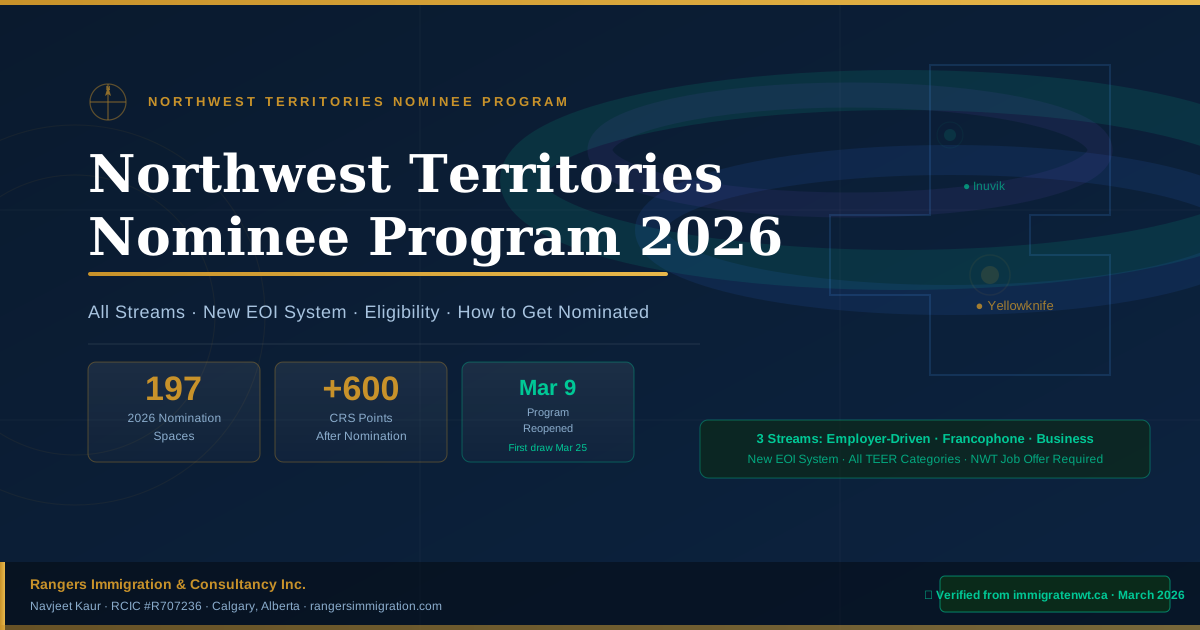
March 2026 Status: The NTNP reopened on March 9, 2026. The first EOI draw is scheduled for March 25, 2026, with up to 65 candidates invited. 2026 nomination allocation: 197 spaces. If you are currently working in the NWT or have a job offer, submit your EOI now. Always verify the current program status at immigratenwt.ca before applying.
The Northwest Territories Nominee Program 2026 has launched with the biggest structural change in its history — a brand new Expression of Interest system for its most popular stream, a reduced nomination allocation, and a March 9 reopening date that signals tight competition from day one.
If you are working in the NWT, have a job offer from an NWT employer, or are exploring the territories as a pathway to Canadian permanent residence, this guide covers everything you need to know about the NTNP in 2026 — all streams, all pathways, eligibility requirements, the new EOI system, and what it takes to be competitive when the first draw runs on March 25.
All information in this guide is verified directly from immigratenwt.ca and official GNWT announcements as of March 2026.
What Is the Northwest Territories Nominee Program?
The Northwest Territories Nominee Program (NTNP) is an economic immigration program administered by the Government of the Northwest Territories (GNWT) in cooperation with Immigration, Refugees and Citizenship Canada (IRCC). It allows the GNWT to nominate foreign nationals for Canadian permanent residence when those individuals intend to live and work in the NWT and meet specific economic and labour market needs.
Like all provincial and territorial nominee programs, the NTNP nomination adds 600 points to your federal Express Entry Comprehensive Ranking System (CRS) score, making an Invitation to Apply (ITA) for permanent residence the near-certain next step for nominees who have an active Express Entry profile.
The program operates across three main streams: the Employer-Driven Stream, the Francophone Stream, and the Business Stream. Each stream targets a different applicant profile and operates under different application rules.
Northwest Territories Nominee Program 2026 — What Changed and Why It Matters
The NTNP entered 2026 with two significant changes that every prospective applicant needs to understand before submitting anything.
Change 1 — Reduced nomination allocation
IRCC granted the NWT a 2026 nomination allocation of 197 spaces. That is the same number the territory ended 2025 with, following a federal increase, but it is well below the 300 nominations the GNWT had worked with earlier in 2025. With 197 total spaces shared across all streams and all pathways, 2026 is one of the most competitive years in recent NTNP history. Every nomination space matters.
Change 2 — New EOI system for the Employer-Driven Stream
For 2026, the NWT introduced an Expression of Interest system for all three pathways under its Employer-Driven Stream. This is a fundamental change from prior years when employers could submit applications directly on a first-come, first-served basis.
Under the new system, employers register first, candidates complete an EOI survey that generates a ranked profile, and GNWT conducts draws from the pool throughout the year — inviting only the highest-scoring candidates to submit full applications.
The Francophone and Business streams are not affected by the EOI change. They continue to operate on a first-come, first-served basis.FCFS intake when open, subject to eligibility and program capacity
Practitioner Note: The timing of this change is critical for anyone currently working in the NWT on an employer-specific work permit. The first draw is March 25, 2026, and only up to 65 candidates will be invited. If your employer has not yet registered and your EOI has not been submitted, you are not in the pool and will not be considered. The process starts with the employer — not the candidate. If your employer does not know they need to register first, the window closes before your profile even exists.
The Three NTNP Streams at a Glance
| Stream | Who It’s For | Selection Method | Opens |
|---|---|---|---|
| Employer-Driven | Workers with an NWT job offer | EOI draws (new 2026) | March 9, 2026 |
| Francophone Stream | Bilingual French/English workers with an NWT job offer | First-come, first-served | March 9, 2026 |
| Business Stream | Entrepreneurs investing in NWT | First-come, first-served | Open year-round |
Stream 1 — Employer-Driven Stream
The Employer-Driven Stream is the largest and most competitive NTNP stream. It is for employers in the NWT who need to hire foreign nationals when no qualified Canadian or permanent resident is available. The stream has three pathways, each targeting a different NOC TEER level.
How the New EOI Process Works in 2026
The EOI process for the Employer-Driven Stream requires the employer and candidate to act in sequence:
Step 1 — Employer registers: The employer must register and create an account in the NWT Nominee Program online portal at ntnp.immigratenwt.ca. The employer selects the Employer-Driven stream and the applicable pathway for the position.
Step 2 — Candidate completes EOI survey: Once the employer has completed their registration, the candidate completes an EOI survey online. The survey generates a scored profile that enters the NTNP candidate pool.
Step 3 — GNWT conducts draws: GNWT reviews the pool and conducts draws throughout the year, selecting the highest-scoring eligible candidates and inviting their employers to submit a full application. The number of draws and candidates per draw depends on the annual allocation.
Step 4 — Full application submitted: Only employers of invited candidates can submit a full NTNP application. Applications are assessed in the order they are received after the draw.
Step 5 — Nomination and federal PR: If approved, GNWT issues a provincial nomination certificate. The nominee then applies to IRCC for permanent residence — through Express Entry (faster) or the non-EE stream.
The first 2026 draw is scheduled for March 25, 2026, with up to 65 eligible candidates invited. Scores will be published after each draw.
Pathway 1 — Skilled Worker
The Skilled Worker pathway is for occupations in NOC TEER 0, 1, 2, or 3. It targets workers in professional, technical, and skilled occupations who have a valid job offer from an NWT employer.
Candidate eligibility requirements:
- NOC TEER 0, 1, 2, or 3 occupation
- One year of full-time work experience within the last 10 years in the same or similar occupation
- Valid work permit
- Minimum language proficiency in English or French — refer to program guidelines at immigratenwt.ca for the exact CLB requirement for your NOC
Employer role: The employer must demonstrate that they were unable to fill the position locally or nationally before nominating a foreign national. The employer applies on behalf of the candidate.
Pathway 2 — Entry Level / Semi-Skilled Occupations
The Entry Level/Semi-Skilled pathway is for NOC TEER 4 and TEER 5 occupations — positions that require less formal education but are critical to the NWT labour market in sectors like hospitality, retail, food services, and care work.
Candidate eligibility requirements:
- NOC TEER 4 or 5 occupation
- Must have worked full-time for the same NWT employer in the same position for 12 consecutive months at the time of application
- Valid work permit
- Minimum language proficiency in English or French — refer to program guidelines for exact CLB requirement
Key distinction from Skilled Worker: For this pathway, the experience must be with the employer submitting the application — you cannot count work experience from a prior NWT employer. This is the most important rule that self-prepared applicants misunderstand.
Practitioner Note: The 12-month same-employer requirement is where I see most Entry Level pathway applications get refused or delayed. An employee who worked 8 months for one NWT employer and 5 months for another does not meet this requirement — even though they have 13 months of NWT experience. The 12 months must be continuous with the nominating employer.
Pathway 3 — NWT Express Entry
The NWT Express Entry pathway is for skilled workers (TEER 0, 1, 2, 3) who already have an active federal Express Entry profile. It is the fastest route to permanent residence under the NTNP because a nomination triggers an automatic 600-point CRS boost and an ITA in the next available federal draw.
Candidate eligibility requirements:
- Accepted into IRCC’s Express Entry pool with an active profile
- Have a Job Seeker Validation Code
- Have a valid job offer from an NWT employer
- Have a valid work permit
- One year of full-time experience in the last 10 years in the same or similar occupation
- Required certifications or accreditation for the occupation’s NOC code
- Meet the language requirement criteria
- Not a refugee claimant
This pathway is processed through the same EOI draw system as the other Employer-Driven pathways for 2026.
Stream 2 — Francophone Stream
The Francophone Stream is for foreign nationals who speak both French and English and have a valid job offer from an NWT employer. It covers all NOC TEER categories — 0 through 5 — making it the most occupation-inclusive stream in the NTNP.
Key features:
- Open to all NOC TEER categories (0, 1, 2, 3, 4, and 5)
- First-come, first-served — no EOI required
- Must speak both French and English at a minimum level
- Proof of language testing must be provided at the time of application
- Valid job offer from an NWT employer required
- Opened March 9, 2026
Why this matters for bilingual workers: If you are a French-English bilingual worker in a TEER 4 or 5 occupation, the Francophone Stream can be a faster and less competitive pathway than the Employer-Driven stream — because it operates on first-come, first-served basis without EOI draws and because it covers all TEER levels.
Refer to the Francophone Stream program guidelines at immigratenwt.ca for exact language benchmark minimums, as these are set separately from the Employer-Driven stream.
Stream 3 — Business Stream
The Business Stream is for foreign nationals who want to start a business in the NWT, purchase an existing NWT business, or invest in and operate an existing NWT business. It is the only NTNP stream that does not require a job offer from an employer.
Business Stream Eligibility Requirements
Investment minimums:
- Minimum $200,000 CAD equity to start or buy a business within Yellowknife’s corporate boundaries
- Minimum $100,000 CAD equity to start or buy a business outside Yellowknife
Ownership: You must demonstrate you own at least 33.3% of the business, unless your personal equity investment is $1,000,000 CAD or more, in which case a lower ownership percentage is accepted.
Net worth:
- Minimum $500,000 CAD personal net worth for a business within Yellowknife’s corporate boundaries
- Minimum $250,000 CAD personal net worth for a business outside Yellowknife
Language: Minimum CLB 4 in English or the equivalent NCLC in French. Accepted tests: IELTS or CELPIP for English; TEF for French. Test results must be no older than 2 years at time of application.
Other requirements: Reasonable knowledge and understanding of the NWT and its economy; sufficient experience and education to implement the business plan; ability to financially support yourself and any dependents during the Business Performance Agreement period.
Application process note: Business Stream applicants must complete an exploratory visit to the NWT and a face-to-face interview as part of the assessment process. If approved after the interview stage, you are formally invited to submit a full application, including your business plan. If your application is approved, you enter into a Business Performance Agreement — a two-year legal agreement with the GNWT outlining your obligations before receiving a nomination certificate.
NTNP EOI Points — How Your Score Is Calculated
For the Employer-Driven Stream, the EOI ranking system scores candidates on a maximum of 845 points across three broad categories.
Human Capital Factors
| Factor | Maximum Points |
|---|---|
| Language proficiency | 125 |
| Age | 50 |
| Work experience | 100 |
| Education | 100 |
Connections to the NWT Labour Market
| Factor | Maximum Points |
|---|---|
| Level of employment in the NWT | Included |
| Duration of time employed in the NWT | Included |
| Skilled trades job offer | Included |
| Closed (employer-specific) work permit in the NWT | Included |
| Working in a small NWT community | Included |
| Total (Connections category) | 340 |
Adaptability to the NWT
| Factor | Maximum Points |
|---|---|
| Immediate family member living in the NWT | Included |
| Post-secondary education completed in the NWT | Included |
| Total (Adaptability category) | 130 |
Total maximum: 845 points
Download the official Employer-Driven Stream Expression of Interest Points Grid here: employer-driven_stream_expression_of_interest_points_grid.pdf for the precise point values within each sub-factor.
Practitioner Note: The Connections to NWT Labour Market category carries the most weight at 340 points maximum. This means candidates who are already working in the NWT — especially on a closed, employer-specific work permit, in a trades occupation, or in a smaller community — will consistently outscore candidates who are applying from outside the NWT with only a job offer in hand. If you are currently in the NWT and have not yet submitted your EOI, you are sitting on your highest-value points and losing them with every week of delay.
Skilled Trades Bonus
There is a specific bonus for candidates in designated skilled trades occupations. The current trades list includes:
Carpenter (NOC 72310), Electricians (72200), Plumber (72300), Gas fitters (72302), Heavy Duty Equipment Mechanic (72401), Automotive Service Technician (72410), Welder (72106), Industrial Mechanic/Millwright (72400), Aircraft Maintenance Engineer/Mechanic (72404), Air pilots (72600), and Chef (62200).
This list is subject to change — always verify the current list at immigratenwt.ca before submitting your EOI.
NTNP vs. AAIP — Which Is Right for You?
Many workers in northern Alberta and the NWT are in range of both programs. Here is a plain-English comparison:
| Your Situation | Better Fit |
|---|---|
| Working in Alberta, an employer based in Alberta | AAIP — Alberta program |
| Working in NWT, employer based in NWT | NTNP — NWT program |
| In a trades occupation in the NWT | NTNP — trades bonus in EOI gives a strong score |
| TEER 4 or 5 worker already with the same NWT employer for 12+ months | NTNP Entry Level pathway |
| French-English bilingual, NWT job offer | NTNP Francophone Stream — no EOI wait |
| Active Express Entry profile, skilled NWT job offer | NWT Express Entry pathway — fastest PR route |
| Lower CRS score, Alberta job | AAIP AOS — nomination adds 600 CRS points |
For a full comparison of the AAIP and its streams, read our Alberta PNP 2026 Complete Guide.
Step-by-Step: From EOI to Permanent Residence
Step 1 — Employer registers in NTNP portal- The employer creates an account at ntnp.immigratenwt.ca and selects the Employer-Driven stream. This must happen before the candidate can submit an EOI.
Step 2 — Candidate submits EOI survey- Once the employer has completed registration, you complete the EOI survey online. The survey generates your ranked profile in the candidate pool. There is no fee to submit an EOI and no deadline — but the pool is competitive and draw timing matters.
Step 3 — Wait for draw invitation- GNWT conducts draws from the candidate pool. The first 2026 draw is March 25 (up to 65 invitations). Subsequent draws will occur throughout the year. You will be notified if you are selected.
Step 4 — Employer submits full application -If your employer’s EOI profile is invited, the employer submits a full NTNP application on your behalf. Applications are assessed in order of receipt after the draw.
Step 5 — GNWT issues nomination certificate – If approved, you receive your provincial nomination certificate from the GNWT.
Step 6 — Apply to IRCC for permanent residence – With your NTNP nomination, you apply to IRCC for PR. If you have an active Express Entry profile, your CRS score increases by 600 points and you receive an ITA in the next available federal draw. Federal processing after ITA is approximately 6 months for most applicants.
NTNP Eligibility Checklist — Employer-Driven Stream
Before your employer registers and you submit your EOI, confirm all of the following:
Skilled Worker and NWT Express Entry (TEER 0-3):
- Valid work permit authorizing work in the NWT
- 1 year of full-time work experience in the same or similar occupation within the last 10 years
- Valid job offer from an NWT employer in your NOC occupation
- Language test completed at the required minimum level (check program guidelines for your NOC)
- Required certifications or trade qualifications for your occupation (NWT Express Entry)
- Active Express Entry profile with Job Seeker Validation Code (NWT Express Entry only)
- Not a refugee claimant (NWT Express Entry only)
Entry Level/Semi-Skilled (TEER 4-5):
- Valid work permit authorizing work in the NWT
- 12 consecutive months of full-time employment with your current NWT employer in the same position
- Valid job offer from that same employer
- Language test completed at requthe ired minimum level
Frequently Asked Questions — NTNP 2026
The NTNP was closed for most of 2025 — is it definitely open now? Yes. The NTNP Employer-Driven and Francophone streams reopened on March 9, 2026, at 9 am MST. The 2025 intake closed after filling the 300-nomination cap. The 2026 allocation is 197 nominations, and the program is actively accepting EOI submissions as of the reopening date.
Can I submit an EOI without a job offer? No. For all Employer-Driven pathways, the EOI process requires the employer to register first. Without an employer registration, you cannot submit an EOI. The NTNP is entirely employer-driven — you need an NWT job offer before the process can begin.
Does the NTNP nomination guarantee my federal PR application will be approved? No. GNWT nominates you for permanent residence, but IRCC makes the final decision on your federal PR application. Nominations are not approvals. IRCC reviews your nomination separately and can refuse a federal PR application even after a provincial nomination is issued.
Can I apply to the NTNP and another PNP at the same time? No. You cannot have an active application with any other provincial or territorial nominee program while an NTNP application is in progress.
What if my work permit expires while my NTNP application is processing? You must maintain a valid temporary resident status throughout your NTNP application and federal PR processing. If your work permit is expiring, discuss a renewal strategy with a licensed RCIC before your permit lapses — losing status during processing can jeopardize your application.
Is the Business Stream open right now? The Business Stream operates year-round on a first-come, first-served basis and is not affected by the March 9 reopening date for the Employer-Driven and Francophone streams. Contact the GNWT immigration team directly at [email protected] or 1-855-440-5450 for the current Business Stream intake status.
Can my spouse and children be included in my NTNP application? Yes. Dependants, including a spouse or common-law partner and dependent children can be included in your application. They may be eligible for open work permits and study permits, respectively, while the federal PR application processes.
Is the NTNP Right for You? Book a Free Assessment
The Northwest Territories Nominee Program 2026 offers a genuine pathway to permanent residence for workers already in the NWT — but the new EOI system, the 197-space allocation, and the employer-first process mean that preparation and timing now matter more than ever.
Complete our free immigration assessment at rangersimmigration.com/assessment, and I will personally review your NWT work history, your EOI point estimate, your stream eligibility, and your realistic timeline to nomination.
Rangers Immigration & Consultancy Inc. Navjeet Kaur | RCIC #R707236 Calgary, Alberta | Virtual & In-Person Consultations Available Across Canada Consultations available in English, ਪੰਜਾਬੀ & हिन्दी 📞 +1 587 221 1000
This article is for general informational purposes only. All information is verified from immigratenwt.ca and gov.nt.ca as of March 2026. Program criteria, nomination allocations, draw schedules, and eligibility requirements are subject to change without notice. Always verify current requirements at immigratenwt.ca before submitting any application. Reading this article does not create a consultant-client relationship.