
NTNP EOI Ranking 2026 — How the Northwest Territories Scores Candidates and Makes a Competitive Profile
By Navjeet Kaur, RCIC #R707236 | Rangers Immigration & Consultancy Inc., Calgary AB Last Updated: March 2026 | Verified from immigratenwt.ca
March 2026 Status: The NTNP Employer-Driven Stream reopened March 9, 2026, with a new EOI system. First draw: March 25, 2026 — up to 65 candidates invited. Submit your EOI before March 25. Verify current information at immigratenwt.ca.
The NTNP EOI ranking 2026 is the single most important thing to understand if you or your employer is considering the Northwest Territories Nominee Program this year. For the first time, NTNP has replaced its first-come, first-served intake with a scored Expression of Interest system for the Employer-Driven Stream — and not every eligible candidate will receive an invitation.
With only 197 total nominations available for 2026 across all NTNP streams, the EOI system determines who gets a shot at those spaces. Understanding how your profile is scored — and where your highest-value points are — is the difference between receiving an invitation on March 25 and waiting indefinitely.
This guide breaks down the NTNP EOI ranking system as verified from immigratenwt.ca, explains how the draw process works, and tells you exactly where to focus to build the strongest possible profile.
What Is the NTNP EOI System?
The NTNP Expression of Interest system is a scoring and ranking mechanism for the Employer-Driven Stream — not an application. Completing and submitting an EOI does not mean you have applied to the NTNP. It means you have entered a ranked candidate pool from which GNWT selects the highest-scoring profiles through draws held throughout the year.
The process works as follows. Your employer registers in the NTNP online portal at ntnp.immigratenwt.ca and selects the relevant Employer-Driven pathway. You then complete an EOI survey, which generates a scored profile. GNWT ranks all eligible profiles by score and conducts draws, inviting the top-ranked employers to submit full applications. If your employer is invited, you submit a complete application, and it is assessed in the order received.
There is no limit on how many candidates can submit an EOI, and there is no submission deadline. However, only employers of invited candidates can submit a full application — and with 197 total nominations for the entire territory in 2026, not every eligible profile will receive an invitation.
Practitioner Note: The most common mistake I am seeing right now is candidates waiting for their employer to take the first step. The EOI process starts with the employer — not the candidate. If your employer does not know they need to register in the portal before you can submit your EOI, you will miss the first draw entirely. The first draw is March 25. Employers and candidates need to move this week.
How Your EOI Score Is Calculated — Full Breakdown
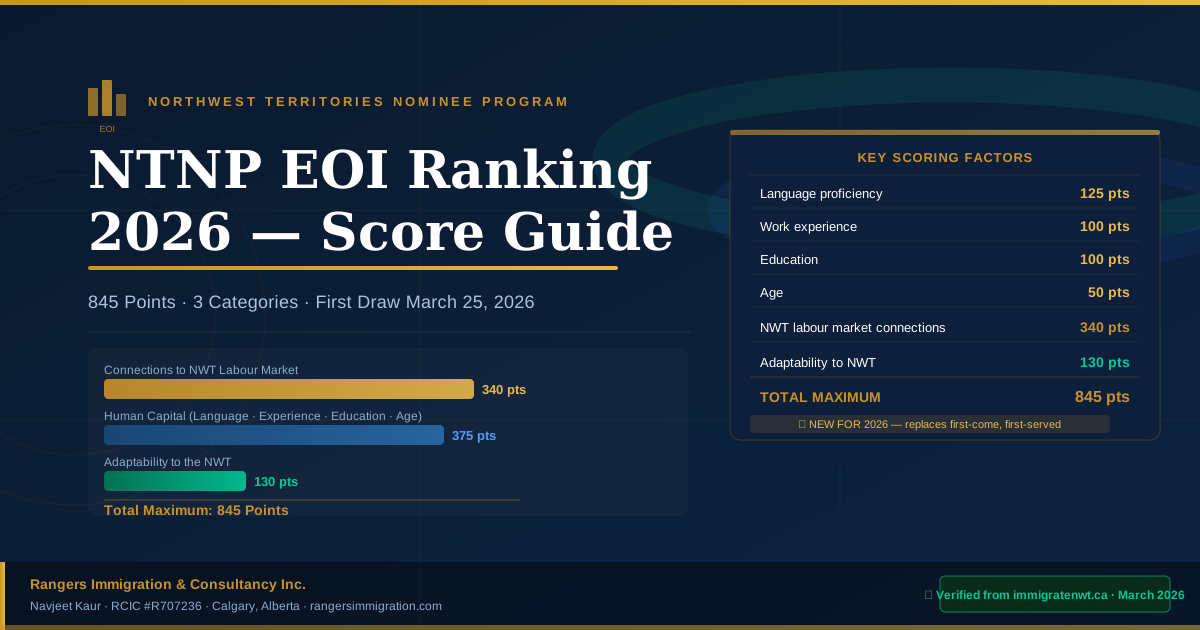
The NTNP EOI ranking system scores candidates on a maximum of 845 points across three categories: Human Capital, Connections to the NWT Labour Market, and Adaptability.
Category 1 — Human Capital (375 points maximum)
Human capital measures what you bring as an individual, independent of your connection to the NWT specifically.
| Factor | Maximum Points |
|---|---|
| Language proficiency | 125 |
| Work experience | 100 |
| Education | 100 |
| Age | 50 |
| Category total | 375 |
Language (125 points): The highest single factor in the Human Capital category. Points are awarded based on your tested proficiency in English or French using an accepted language test. Higher CLB/NCLC scores earn more points. This is one of the few factors you can actively improve before submitting — retaking a language test if you are close to a higher band is worth considering.
Work experience (100 points): Points are awarded based on your work experience in your current occupation. This factor rewards depth of experience — workers with more years in their occupation will score higher than those who just cross the minimum threshold.
Education (100 points): Higher education levels earn more points. A post-secondary credential will score better than a high school diploma; a degree or professional designation will score higher still.
Age (50 points): Age points reflect where you fall in your career. The NWT, like most PNPs, awards higher points to prime working-age candidates. This is not something you can change, but it is worth knowing where you stand relative to other candidates.
Category 2 — Connections to the NWT Labour Market (340 points maximum)
This is the most heavily weighted category — 340 of 845 possible points. It directly rewards candidates who are already embedded in the NWT economy and workforce.
Sub-factors in this category include:
Level of employment in the NWT: Whether you are currently working in the NWT, and in what capacity, earns points here. A candidate currently employed full-time in the NWT will score significantly higher than a candidate applying from outside the territory with only a job offer.
Duration of employment in the NWT: The longer you have worked in the NWT continuously, the more points you earn. This rewards retention — candidates who have been contributing to the territory’s economy for years are prioritized over recent arrivals.
Skilled trades job offer: If your job offer is in one of the NTNP’s designated skilled trades occupations, you earn additional points here. The current trades list includes: Carpenter (NOC 72310), Electricians (72200), Plumber (72300), Gas fitters (72302), Heavy Duty Equipment Mechanic (72401), Automotive Service Technician (72410), Welder (72106), Industrial Mechanic/Millwright (72400), Aircraft Maintenance Engineer/Mechanic (72404), Air pilots (72600), and Chef (62200). This list is subject to change — always verify at immigratenwt.ca.
Closed (employer-specific) work permit in the NWT: Holding a closed work permit tied to your NWT employer earns additional points. This signals deeper commitment and a more established employment relationship than an open work permit.
Working in a small NWT community: Candidates employed in smaller NWT communities outside of Yellowknife earn additional points. This reflects the territory’s goal of supporting population growth and labour retention in communities beyond the capital.
Practitioner Note: Category 2 is where the competition is won or lost. A candidate who has been working in Inuvik on a closed work permit for three years in a trades occupation is going to score substantially higher than a candidate who just received a job offer in Yellowknife and has never worked in the NWT. If you are already in the NWT, you are sitting on your best points. If you are applying from outside the NWT, your Connections score will be limited and your Human Capital and Adaptability sections need to be as strong as possible to compensate.
Category 3 — Adaptability to the NWT (130 points maximum)
Adaptability factors measure ties that suggest you are likely to remain in the NWT long-term after receiving permanent residence — a key GNWT priority.
Immediate family member in the NWT: If you have a parent, sibling, spouse, or child who is a Canadian citizen or permanent resident living in the NWT, you earn points here. Family ties are one of the strongest predictors of immigrant retention, and the NTNP rewards them.
Post-secondary education completed in the NWT: If you completed a post-secondary program at an NWT institution, you earn points in this sub-factor. This applies to degree, diploma, and certificate programs.
Full EOI Points Summary
| Category | Maximum Points |
|---|---|
| Language | 125 |
| Work experience | 100 |
| Education | 100 |
| Age | 50 |
| Connections to NWT Labour Market | 340 |
| Adaptability to NWT | 130 |
| Total | 845 |
Download the official Employer-Driven Stream Expression of Interest Points Grid here: employer-driven_stream_expression_of_interest_points_grid.pdf for the specific point values within each sub-factor — and the PDF contains the complete breakdown.
The 2026 Draw Schedule — What to Expect
GNWT has confirmed the following about the 2026 draw schedule:
- First draw: March 25, 2026 — up to 65 eligible candidates invited
- Subsequent draws: Multiple draws throughout 2026 — exact dates not pre-announced
- Draw frequency: Draws are conducted as needed based on available nomination spaces and territorial priorities, not on a fixed monthly schedule
- Results publication: After each draw, GNWT will publish the number of applicants selected and the range of scores for selected candidates
- Applications after invitation: Applications from invited candidates are assessed in the order they are received — not by work permit expiry date (this was corrected from an earlier government announcement)
With 197 total nominations for the entire NWT in 2026, the number of invitations across all draws will be limited. Early draws may be larger if the pool is deep; later draws will depend on how many nominations remain.
What Score Is Competitive in 2026?
The 2026 EOI system is brand new — there is no prior draw history to reference for cut-off scores. No one can reliably predict minimum scores until the first draws have been conducted and published.
What we do know is this: with 340 points concentrated in the Connections to NWT Labour Market category, candidates who are already living and working in the NWT on employer-specific work permits will have a structural scoring advantage over candidates applying from outside the territory.
The practical implication is that if you are currently in the NWT in an eligible occupation with an NWT employer, your EOI should be submitted as soon as your employer registers. Waiting reduces nothing and risks missing a draw.
After the first draw on March 25, GNWT will publish the score range of invited candidates. That data will be the first real benchmark for 2026 — and this article will be updated when it is published.
How to Build the Strongest Possible NTNP EOI 2026 Profile
Based on the verified points structure, here is where to focus:
If you are currently working in the NWT : Your Connections to NWT Labour Market score is your biggest asset. Document your employment history in the NWT carefully — start date, employer, work permit type, and community. If you are in a designated trades occupation, confirm you are claiming the trades bonus. The longer you have been in the NWT and the more employer-specific your work permit, the stronger your Category 2 score.
If you are applying from outside the NWT: Your Human Capital score carries almost all your weight. Maximize language — if you are near a higher CLB band, retest. Ensure your education credentials are correctly documented (ECA if foreign credentials). Your Connection score will be limited, so you need near-maximum Human Capital points to be competitive.
For bilingual French-English candidates: Seriously consider the Francophone Stream before the Employer-Driven Stream. The Francophone Stream covers all TEER categories, operates on a first-come, first-served basis with no EOI wait, and opened on March 9. If you meet the bilingual requirement, you may be able to get a nomination faster through the Francophone Stream than waiting for an EOI draw.
For NWT Express Entry candidates: If you have an active Express Entry profile with a Job Seeker Validation Code, the NWT Express Entry pathway under the Employer-Driven Stream is your fastest route to PR. Nomination adds 600 CRS points, making an ITA near-certain in the next federal draw. The EOI system applies to NWT Express Entry, too — but the post-nomination federal processing is approximately 6 months.
Ready to Find Out Where You Stand?
The NTNP EOI ranking for 2026 rewards candidates already embedded in the NWT — but it also rewards preparation. Knowing your score estimate before your employer submits the EOI means you can identify gaps, strengthen weak categories, and enter the pool in the best possible position for the March 25 draw.
Complete our free immigration assessment at rangersimmigration.com/assessment, and I will personally calculate your estimated EOI score, review your stream eligibility, and advise on whether the Employer-Driven Stream, Francophone Stream, or another pathway is your strongest option for 2026.
For a complete overview of all NTNP streams and how the program works, read our NTNP 2026 Complete Guide.
Rangers Immigration & Consultancy Inc. Navjeet Kaur | RCIC #R707236 Calgary, Alberta | Virtual & In-Person Consultations Available Across Canada Consultations available in English, ਪੰਜਾਬੀ & हिन्दी 📞 +1 587 221 1000
This article is for general informational purposes only. All information is verified from immigratenwt.ca as of March 2026. The EOI points grid, draw schedules, nomination allocations, and eligibility requirements are subject to change without notice. This article will be updated after the first March 25 draw when score ranges are published. Always verify current requirements at immigratenwt.ca before submitting any application. Reading this article does not create a consultant-client relationship.