
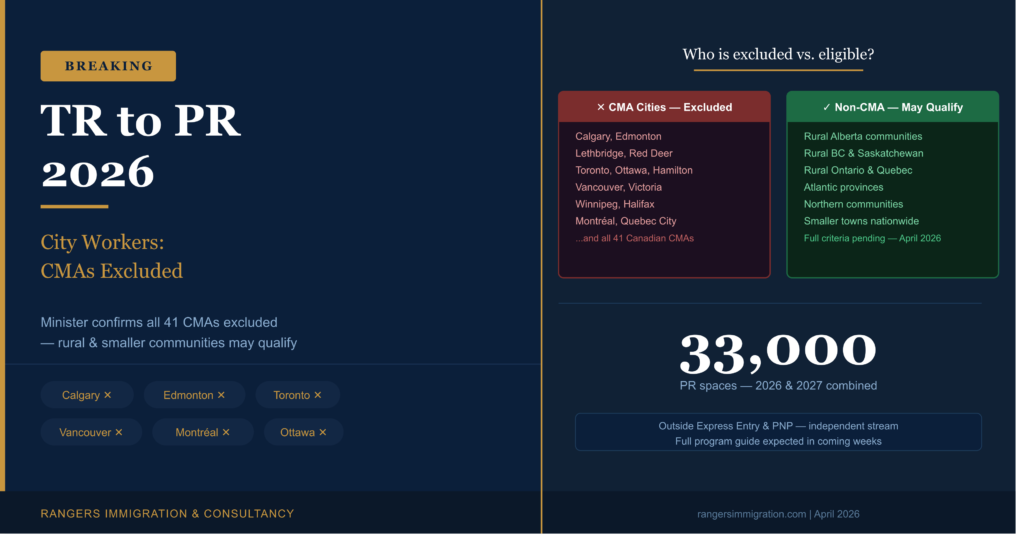
TR to PR 2026: Major Canadian Cities Excluded — What Every Temporary Worker Needs to Know
Published: April 2026 | Category: TR to PR, Express Entry, Canadian Immigration | Author: Rangers Immigration & Consultancy
Canada’s new Temporary Resident to Permanent Resident (TR to PR) pathway just got a major update — and if you live in one of Canada’s larger cities, it may directly affect whether you qualify.
In an April 18, 2026, interview with I’m Canada, Immigration Minister Lena Diab confirmed that the 33,000-spot TR to PR pathway will exclude all Census Metropolitan Areas (CMAs). That is a classification that covers Canada’s largest urban centres from coast to coast — home to roughly 72% of the country’s total population.
Here is a full breakdown of what was said, which cities are excluded, what the program actually looks like, and what your options are depending on where you live.
What Did the Minister Say?
Immigration Minister Lena Metlege Diab has given two key interviews on the TR-to-PR pathway.
On March 6, 2026, she confirmed to the Toronto Star that the program had already been soft-launched, with full eligibility criteria and application instructions to follow in April.
Then on April 18, 2026, in a new interview with I’m Canada, Minister Diab revealed a significant restriction: the program will exclude all Census Metropolitan Areas (CMAs). She also indicated that “much more” of the full selection criteria would be published in the coming weeks.
As of this writing, IRCC has not yet released the complete program guide or opened the online application portal.
What Is a CMA?
A Census Metropolitan Area (CMA) is a geographic classification defined by Statistics Canada. To qualify as a CMA, an area must have a total population of at least 100,000, with at least 50,000 people living in the urban core.
Canada currently has 41 CMAs. Together, they are home to approximately 72% of Canada’s total population. This means the TR to PR pathway — despite being described as a program for workers already living in Canada — is effectively unavailable to the majority of the country’s temporary foreign worker population, most of whom are concentrated in large urban centres.
Which Cities Are Excluded Across Canada?
All 41 Canadian CMAs are excluded. The major ones include:
British Columbia: Vancouver, Victoria, Abbotsford-Mission, Kelowna, Kamloops, Chilliwack, Nanaimo
Alberta: Calgary, Edmonton, Lethbridge, Red Deer
Saskatchewan: Saskatoon, Regina
Manitoba: Winnipeg
Ontario: Toronto, Ottawa-Gatineau (Ontario part), Hamilton, London, Kitchener-Cambridge-Waterloo, Windsor, Oshawa, Barrie, Kingston, Thunder Bay, St. Catharines-Niagara, Guelph, Brantford, Belleville-Quinte West, Peterborough, Sudbury, Sault Ste. Marie
Québec: Montréal, Québec City, Gatineau (Ottawa-Gatineau Québec part), Sherbrooke, Drummondville, Saguenay, Trois-Rivières
New Brunswick: Moncton, Saint John, Fredericton
Nova Scotia: Halifax
Newfoundland and Labrador: St. John’s
You can verify whether your specific community falls within a CMA using Statistics Canada’s official CMA reference list at statcan.gc.ca.
The Program: Key Facts Confirmed So Far
While the full criteria are still pending, here is what has been officially confirmed about the 2026 TR-to-PR pathway.
This is a one-time federal measure under Canada’s 2026–2028 Immigration Levels Plan. It will grant permanent residence to up to 33,000 temporary foreign workers over 2026 and 2027 — approximately 16,500 spaces per year. The pathway operates entirely outside of Express Entry and the Provincial Nominee Program (PNP). It is an independent stream.
It targets temporary foreign workers already living and working in Canada, with a focus on in-demand sectors and rural communities. All Census Metropolitan Areas are excluded, as confirmed on April 18, 2026.
The full application guide and online portal have not yet been released. Minister Diab indicated that more criteria are coming in the next few weeks.
Why it was created: Government data shows that more than 2.1 million temporary resident permits expired in 2025, with a further 1.9 million expected to expire in 2026. Prime Minister Mark Carney has pledged to reduce the non-permanent resident population to below 5% of Canada’s total population by 2027 — down from approximately 6.8% as of December 2025. Transitioning eligible workers already in Canada to permanent residence is one approach to managing this without large-scale removals.
What Is Expected — But Not Yet Official
Based on government statements and the structure of the 2021 TR to PR pathway, experts anticipate the following — but these are not confirmed by IRCC:
- Valid Canadian work permit at the time of application
- Employment in a specific in-demand sector (full NOC list not yet released)
- Minimum language proficiency at the Canadian Language Benchmark (CLB) level — exact minimums not yet stated
- At least one year of Canadian work experience (based on 2021 precedent)
- Educational Credential Assessment (ECA) for foreign credentials
- Clean admissibility record
- Residing and working outside a CMA
None of the above should be treated as final until IRCC publishes the official program guide.
How It Compares to the 2021 Program
Many temporary workers remember the 2021 TR to PR pathway. The 2026 version is significantly different in several key ways.
The 2021 program offered 90,000 spaces across six streams — including healthcare workers, essential workers in non-health fields, and recent international graduates. It launched on May 6, 2021, and hit its intake cap by July 16, 2021 — roughly two months after opening.
The 2026 version is smaller (33,000 vs. 90,000 spots), more sector-specific, carries a stronger rural focus, and explicitly excludes all CMAs. There is no international graduate stream confirmed for 2026. The program has also been soft-launched, meaning it is already active in the background rather than opening on a single announced date.
Given the smaller allocation and narrower eligibility, competition for spots will be intense among those who do qualify.
If You Live Outside a CMA: Start Preparing Now
If you live and work in a non-CMA community anywhere in Canada, you may be among the workers this program is designed for. Do not wait for the portal to open before preparing your documents.
These are the documents that virtually every Canadian PR program requires, and the TR to PR pathway is expected to be no different.
Language test results are a cornerstone of the application. Book IELTS General Training, CELPIP-General, PTE Core, TEF Canada, or TCF Canada now. Results must be valid at the time of application (valid for two years from the test date). Aim for CLB 7 or higher to be competitive, though official minimums are not yet confirmed.
An Educational Credential Assessment (ECA) is required if you completed your education outside Canada. ECAs must be from an IRCC-approved organization such as WES, IQAS, ICES, or CES, and are valid for five years.
Police certificates are required for every country where you have lived for six months or more since the age of 18. Processing times vary significantly by country — some jurisdictions take four to eight weeks. Request these immediately.
Employment records — including pay stubs, T4 slips, and reference letters on company letterhead — must confirm your job title, duties, hours, and salary. Letters should describe how your duties align with a specific NOC code.
Proof of valid status means copies of your current work permit and all previous permits. A lapse in status, even briefly, can affect eligibility for any federal PR program.
Passport and travel history: A valid passport plus a complete travel history for the last 10 years or since age 18.
Family member documents: If you plan to include a spouse or dependent children, prepare their passports, police certificates, and travel histories in parallel — not after finishing your own.
If You Live in a CMA: What Are Your Options?
If you are among the majority of temporary foreign workers living in a CMA, the TR to PR pathway is likely not the right route for you. That does not mean you are without options — it means your focus needs to be directed elsewhere.
Express Entry remains the most direct federal pathway for skilled workers. The Canadian Experience Class (CEC) is designed specifically for temporary foreign workers with Canadian work experience. Category-based selection draws have been running regularly for healthcare, trades, agriculture, and other in-demand sectors, sometimes at lower CRS thresholds than general draws.
Provincial Nominee Programs (PNPs) operate in every province and territory, and many have streams designed for workers already established in that province. Alberta, Ontario, British Columbia, Manitoba, and others all run active draws. A provincial nomination adds 600 points to an Express Entry profile, effectively guaranteeing an invitation to apply.
Spousal Sponsorship is available if you have a Canadian citizen or permanent resident spouse or common-law partner willing to sponsor you. Both inland and outland sponsorship options exist, depending on your circumstances.
Other federal programs — including the Agri-Food Pilot for specific food processing and agricultural roles, the Atlantic Immigration Program, and Rural and Northern Immigration Pilot communities — may be relevant depending on your occupation and location.
The right pathway depends on your specific profile: your NOC code, language scores, years of Canadian work experience, education, and work permit type. Speaking with a Regulated Canadian Immigration Consultant (RCIC) is the most reliable way to identify which route genuinely fits your situation.
Alberta Workers: What This Means for You
Alberta has four CMAs — Calgary, Edmonton, Lethbridge, and Red Deer. All four are excluded from the 2026 TR to PR pathway.
For temporary foreign workers in Calgary and Edmonton — where the vast majority of Alberta’s TFW population is concentrated — the TR to PR program is not a realistic option based on current information. Redirecting time and resources toward Express Entry or the Alberta Advantage Immigration Program (AAIP) is the more practical path.
The AAIP includes several active streams: the Alberta Opportunity Stream for workers in eligible occupations, the Rural Renewal Stream for workers in smaller Alberta communities, and sector-specific draws run throughout the year. The province conducts regular AAIP draws and continues to prioritize workers in healthcare, trades, technology, and agriculture.
Workers in smaller Alberta communities outside the four CMAs — such as Grande Prairie, Fort McMurray, Lloydminster, Medicine Hat, or rural areas throughout the province — may still be in scope for the TR to PR pathway, pending confirmation of the full criteria and NOC list.
If you are uncertain whether your Alberta community falls inside or outside a CMA boundary, you can verify using Statistics Canada’s online geographic lookup tool at statcan.gc.ca.
What We Still Do Not Know
It is important to be clear about what has not been confirmed. As of April 20, 2026:
- The full list of eligible NOC codes and sectors has not been published
- Minimum language score (CLB) requirements have not been officially stated
- Minimum Canadian work experience requirements have not been specified
- Whether the exclusion applies strictly to the CMA boundary or a broader surrounding area has not been clarified
- The exact application portal open date has not been officially confirmed
Minister Diab stated on April 18 that more criteria are coming in the next few weeks. Rangers Immigration is monitoring IRCC closely and will publish a follow-up post the moment the full program guide is released.
What Most Immigration Content Is Missing
The majority of blogs covering this program focus on the 33,000 spots and urge readers to prepare documents immediately. That advice is reasonable for those who qualify — but it is missing the most important eligibility factor for most Canadians.
If you live in a CMA, preparing documents for a program that excludes your area is not the best use of your time or money right now. The first question is not “how do I prepare?” — it is “do I even qualify?” Knowing your actual eligibility before investing in language tests, ECAs, and police certificates is the step that comes first.
Summary: Key Takeaways
- The 2026 TR to PR pathway will grant PR to 33,000 temporary foreign workers over 2026 and 2027
- All 41 Census Metropolitan Areas are excluded — confirmed by Minister Diab on April 18, 2026
- This affects workers in major cities, including Toronto, Vancouver, Montreal, Calgary, Edmonton, Ottawa, Winnipeg, Halifax, and dozens more
- The program targets workers in rural communities and smaller centres in in-demand sectors
- Full eligibility criteria, NOC codes, and the application portal have not yet been released
- Workers in CMAs should focus on Express Entry, PNPs, or other federal pathways instead
Next Steps
If you live outside a CMA anywhere in Canada: Start gathering documents now: language test, ECA, police certificates, and employment records. Do not wait for the portal to open.
If you live in a CMA: Book a consultation with a licensed RCIC to assess your Express Entry profile, PNP eligibility, or other options. Do not pause your immigration plans waiting for a program that likely does not apply to you.
For everyone: Maintain your valid immigration status. Apply to extend your work permit before it expires. A lapse in status can affect eligibility for any permanent residence program.
Rangers Immigration & Consultancy Inc. is a Calgary-based consultancy licensed to practice in Alberta and the Northwest Territories. Our RCIC, Navjeet Kaur (R707236), assists clients across Express Entry, Spousal Sponsorship, AAIP, Work Permits, TR to PR, Super Visa, and NWT PNP. Contact us to book a consultation.
Sources:
- CIC News — “BREAKING: Major Canadian cities excluded from new TR to PR pathway, minister says” (April 20, 2026)
- CIC News — “Canada’s new TR to PR pathway has launched” (March 10, 2026)
- Statistics Canada — Census Metropolitan Area definition and full CMA list, 2021 Census
- IRCC — Canada’s 2026–2028 Immigration Levels Plan