
Express Entry 2026: Canada’s Most Significant Immigration Reform in a Decade
Category: Express Entry Published by: Rangers Immigration & Consultancy Inc. — Navjeet Kaur, RCIC #R707236
Canada’s Express Entry system has been selecting skilled immigrants since 2015. Over that decade, principal applicants have consistently out-earned the Canadian median, and the vast majority work in occupations that match their education and skills. By any measure, the system has performed well.
In April 2026, Jonathan Joshi-Koop, Director of IRCC’s Skilled Workers and Business Division, led an official technical briefing for stakeholders. His team presented the most comprehensive proposed reforms to Express Entry since the system launched. Specifically, the briefing covered proposed changes to all three federal programs and to the Comprehensive Ranking System (CRS) that ranks every candidate.
This article breaks down every proposed change — what IRCC presented, the evidence behind each decision, and what it means for your profile in practical terms.
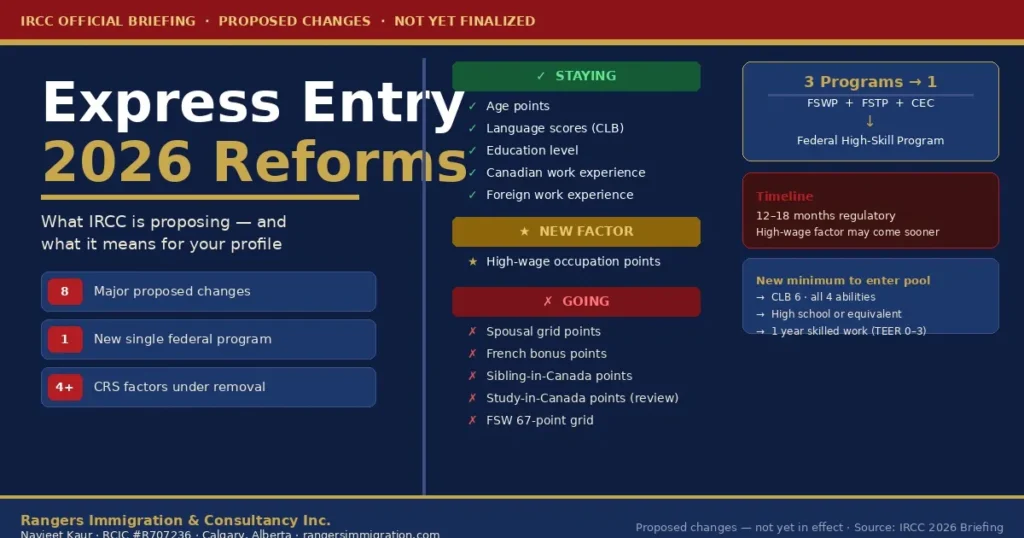
Please note: Every change in this article is a proposal only. IRCC has not implemented or finalized any of these reforms. The standard regulatory process takes between 12 and 18 months, and no confirmed implementation date exists as of publication. This article is for informational purposes only and does not constitute immigration advice. Always consult a Regulated Canadian Immigration Consultant before acting on proposed regulatory changes.
Why IRCC Is Proposing These Reforms
Understanding the rationale matters as much as understanding the changes themselves. IRCC’s briefing deck opens with four guiding principles that frame every decision in the package.
First, IRCC wants to prioritize the strongest predictors of economic success. After more than a decade of data, the department now has clear evidence about which CRS factors genuinely predict long-term employment and earnings outcomes — and which do not. Consequently, the reform strengthens the former and eliminates the latter.
Second, IRCC aims to reduce overlap and duplication. In recent years, approximately half of all candidates who received an Invitation to Apply qualified under at least two of the three federal programs simultaneously. As a result, the three-program architecture had become structurally redundant, with each program functioning only as a minimum entry filter rather than a meaningful selection tool.
Third, the department wants to reduce complexity. Three overlapping programs, each with slightly different rules, create unnecessary friction for candidates and officers alike. Therefore, IRCC is moving toward a leaner, more coherent framework.
Fourth, IRCC wants to promote equity and ensure integrity. This means reducing fraud opportunities and addressing situations where the current system produces unintended consequences — including cases where the spousal grid has inadvertently encouraged family separation.
Proposed Change 1: Three Programs Consolidated Into One
IRCC proposes to eliminate the three current federal programs — the Federal Skilled Worker Program (FSWP), the Federal Skilled Trades Program (FSTP), and the Canadian Experience Class (CEC) — and replace them with a single Federal High-Skill Program.
All three programs would cease to exist as distinct streams. Instead, one program with one unified set of eligibility criteria would govern entry into the Express Entry pool for all candidates.
Two specific mechanisms would disappear under this proposal. First, the FSW 67-point intake grid — the assessment FSWP applicants currently must pass to enter the pool — would be eliminated. Second, the FSTP requirement for either a job offer or a Certificate of Qualification to enter would also be removed. Both requirements duplicated factors that the CRS already assesses and rewards.
New Unified Minimum Entry Criteria
Under the proposed Federal High-Skill Program, every candidate must satisfy three requirements to enter the Express Entry pool:
Education: A Canadian high school diploma or its equivalent. IRCC deliberately set this threshold low to ensure that skilled trades workers without post-secondary credentials can still qualify. Moreover, IRCC confirmed that over 95% of current pool members already meet this standard.
Language proficiency: Canadian Language Benchmark (CLB) 6 in all four abilities — reading, writing, listening, and speaking. IRCC’s research shows that CLB 6 is the level at which language proficiency begins to produce measurable improvements in earnings outcomes. Similarly, approximately 95% of current pool members already meet this bar.
Work experience: At least one year of cumulative skilled work in a NOC TEER category 0, 1, 2, or 3 occupation, acquired in Canada or abroad. This requirement aligns with Express Entry’s core purpose — selecting candidates with demonstrated skilled work histories.
IRCC’s modelling confirms that over 95% of current pool members would meet all three criteria under the new program. In short, the new framework is broadly accessible at the entry level, with differentiation happening at the CRS ranking stage.
Proposed Change 2: A New High-Wage Occupation Factor in the CRS
IRCC proposes to award CRS bonus points to candidates who hold Canadian work experience or a job offer in a qualifying high-wage occupation. Importantly, the assessment uses the occupational median wage — not the individual’s personal salary. IRCC would draw on Statistics Canada and ESDC data to establish each NOC occupation’s median hourly wage, then compare it against the national Canadian median. Any occupation with a median above the national median qualifies.
Additionally, IRCC would publish and maintain a list of qualifying occupations, updated annually.
Three Tiers, Three Levels of Bonus Points
The proposed structure uses three wage thresholds, each generating a different level of CRS bonus points:
Tier 1 — Occupations paying 2× the national median hourly wage. These candidates receive the highest tier of CRS bonus points.
Tier 2 — Occupations paying 1.5× the national median hourly wage. These candidates receive the second tier of bonus points.
Tier 3 — Occupations paying 1.3× the national median hourly wage. These candidates receive the third tier of bonus points.
Two additional rules apply. First, Canadian work experience in a high-wage NOC outweighs a job offer in the same tier — candidates receive points for one or the other, not both. Second, candidates with Canadian work experience in a non-qualifying occupation are not penalized. They continue receiving standard Canadian work experience CRS points and simply do not qualify for the additional high-wage bonus.
Proposed Change 3: Strengthening Recognition of Canadian Licensure
Trades Workers and the Red Seal Standard
Currently, the CRS awards bonus points for Certificates of Qualification (COQ) across a broad range of trades. Under the proposed changes, however, only COQs issued for Red Seal-designated trades would qualify. This narrowing reflects the nationally recognized standard that the Red Seal program represents and gives IRCC officers clearer, more consistent assessment criteria.
More significantly, IRCC proposes to introduce new CRS points for candidates actively working as registered Red Seal apprentices — even before they complete certification. This is a meaningful shift. Previously, trades workers had to wait until they held full certification to benefit from this pathway. Under the proposal, candidates progressing through a Red Seal apprenticeship program would earn CRS points during their training, not after it.
Regulated Professions Beyond Trades
Beyond trades, IRCC is also exploring a separate mechanism to recognize regulated professionals who already hold Canadian licensure — including engineers, nurses, and other regulated occupations. The department is examining whether new CRS points should reward candidates who are, in IRCC’s own words, “practice-ready” in Canada. Furthermore, IRCC is looking at reducing duplication between language testing requirements for immigration and those required for professional licensure — a frustration that currently forces qualified professionals to demonstrate the same language competency twice through separate processes.
Together, both tracks share a consistent objective: prioritizing candidates who can contribute to the Canadian labour market from day one.
Proposed Change 4: Removal of the Spousal Grid
The CRS currently includes a spousal grid that calculates bonus points based on an accompanying spouse’s language proficiency and education level. This grid contributes up to 40 CRS points. IRCC proposes to eliminate it.
Two distinct problems underlie this proposal. First, the evidentiary case: IRCC’s research shows that a spouse’s human capital attributes are a relatively weak predictor of the principal applicant’s own long-term economic outcomes. Consequently, the spousal grid adds complexity without meaningfully improving selection accuracy.
Second, the structural problem: because the grid calculates spousal points relative to the principal applicant’s own profile, it can — in some cases — reduce a candidate’s CRS score rather than increase it. This has created a documented unintended consequence. Some candidates have been choosing to immigrate as single applicants, leaving their spouse behind temporarily and intending to sponsor them later. In effect, the current system financially incentivizes a form of temporary family separation that no immigration policy should encourage.
Removing the spousal grid addresses both problems simultaneously. It eliminates a weak selection factor and creates a consistent, fair playing field for all candidates, regardless of marital status. Importantly, this change does not restrict a principal applicant’s right to bring their spouse as an accompanying dependent.
Proposed Change 5: Removal of French Language Bonus Points
The CRS currently awards up to 50 additional points for French language proficiency. IRCC proposes to remove these bonus points from the ranking system.
Many candidates will misread this change as a signal that IRCC is deprioritizing Francophone immigration. It is not. IRCC’s Director was explicit on this point: supporting Francophone minority communities outside Quebec remains a stated government priority. However, the mechanism for achieving that priority is changing.
The introduction of category-based selection in 2023 gave IRCC a more effective and precise tool. A dedicated Francophone category-based draw allows IRCC to directly control both the volume and the profile of Francophone immigrants it selects. By contrast, a passive bonus in the general ranking system cannot be adjusted with the same precision.
Additionally, the evidence supports this direction. While overall official language proficiency is among the strongest predictors of economic success, the specific French bonus points — when analyzed alongside all other CRS factors — are a comparatively weak predictor of long-term earnings. The general language points remain intact. Only the supplementary French bonus is proposed for removal.
For French-speaking candidates, therefore, the pathway shifts from relying on general CRS bonus points to being prioritized through dedicated Francophone category rounds.
Proposed Change 6: Study-in-Canada Points Under Review
The CRS currently awards bonus points for Canadian post-secondary education — 15 points for one to two years of study and 30 points for a three-year degree or above. IRCC is reviewing whether to keep, narrow, or eliminate these points.
IRCC’s analysis found that the study-in-Canada bonus is a relatively weak predictor of long-term economic outcomes when all other CRS factors are accounted for. Three options remain under consideration: full removal, retention in the current form, or restriction to higher levels of Canadian education — such as graduate degrees — where the link to earnings outcomes is stronger.
Notably, this is the only proposed change in the briefing where IRCC has not indicated a clear direction. The outcome remains genuinely open.
Proposed Change 7: Removal of Sibling-in-Canada Points
The CRS currently awards 15 points to candidates who have a sibling who is a Canadian citizen or permanent resident. IRCC proposes to remove these points.
IRCC’s research found that having a sibling in Canada is a weak predictor of the principal applicant’s economic outcomes. Beyond the evidentiary weakness, however, there is also a fairness concern. In close-ranked pools, 15 points can be determinative. As a result, a candidate with a family connection in Canada can rank above a candidate with demonstrably stronger language scores and work experience — purely based on that family connection. This outcome is inconsistent with an evidence-based selection framework.
Proposed Change 8: Removal of the 600 PT Nomination Points
The CRS currently awards 600 points to candidates who hold a valid provincial or territorial nomination. This effectively guarantees them an Invitation to apply by floating their score to the top of the pool. Under the proposal, IRCC would remove these 600 points.
IRCC’s Director addressed this explicitly: the practical impact on provincial nominees is effectively nil. Provincial nominees will continue receiving ITAs through dedicated PNP-only draw rounds — a mechanism IRCC has already operated for several years. In practice, the 600-point boost had become a redundant technical workaround. PNP-only draws achieve the same outcome more cleanly and efficiently.
Summary: Current CRS vs Proposed Framework
| Factor | Current Status | Proposed Change |
|---|---|---|
| Federal programs | FSWP, FSTP, CEC | Consolidated into the Federal High-Skill Program |
| FSW 67-point grid | Required for FSWP entry | Eliminated |
| FSTP job offer / COQ requirement | Required for FSTP entry | Eliminated |
| Language minimum | Varies by program | CLB 6 all abilities — standardized |
| Education minimum | Varies by program | High school diploma or equivalent |
| Work experience minimum | Varies by program | 1 year TEER 0–3 — Canada or abroad |
| Age | Max 110 pts (ages 20–29) | No change |
| First official language | Max 136 pts at CLB 10+ | No change |
| Second official language | Points available | No change |
| Education (CRS) | Max 150 pts for PhD | No change |
| Canadian work experience | Max 80 pts for 5+ years | No change — high-wage bonus added |
| High-wage occupation factor | Not in CRS | New — tiered bonus points, 3 tiers |
| Job offer | Removed March 2025 | Reintroduced for high-wage NOCs only |
| Certificate of Qualification | Broad trades eligibility | Narrowed to Red Seal trades only |
| Red Seal apprenticeship | No CRS points | New CRS points proposed |
| Regulated profession licensure | No specific recognition | New points being explored |
| Spousal grid | Up to 40 CRS points | Proposed removal |
| French proficiency bonus | 50 CRS points | Proposed removal or modification |
| Sibling in Canada | 15 CRS points | Proposed removal or modification |
| Study in Canada | 15–30 CRS points | Under review |
| PT Nomination | 600 CRS points | Removed — replaced by PNP-only draws |
Conclusion
Express Entry has served Canada’s immigration objectives well. The outcomes data confirm this clearly. Nevertheless, this reform signals a meaningful recalibration — away from a system that rewards the accumulation of various human capital indicators, and toward one that specifically prioritizes demonstrated earnings potential in the Canadian labour market.
The team at Rangers Immigration and Consultancy Inc. is monitoring all IRCC developments closely. If you have questions about how these proposed Express Entry 2026 changes apply to your specific situation, book a consultation with our licensed RCICs today.
This article is based exclusively on information disclosed in IRCC’s official technical briefing on proposed changes to the Express Entry system, including the full stakeholder briefing deck presented in April 2026. All changes described are proposed and have not been implemented as of the date of publication. This article is provided for informational purposes only and does not constitute immigration advice. For guidance specific to your circumstances, consult a Regulated Canadian Immigration Consultant (RCIC). Rangers Immigration and Consultancy Inc. — Navjeet Kaur, RCIC #R707236 — Calgary, Alberta.