
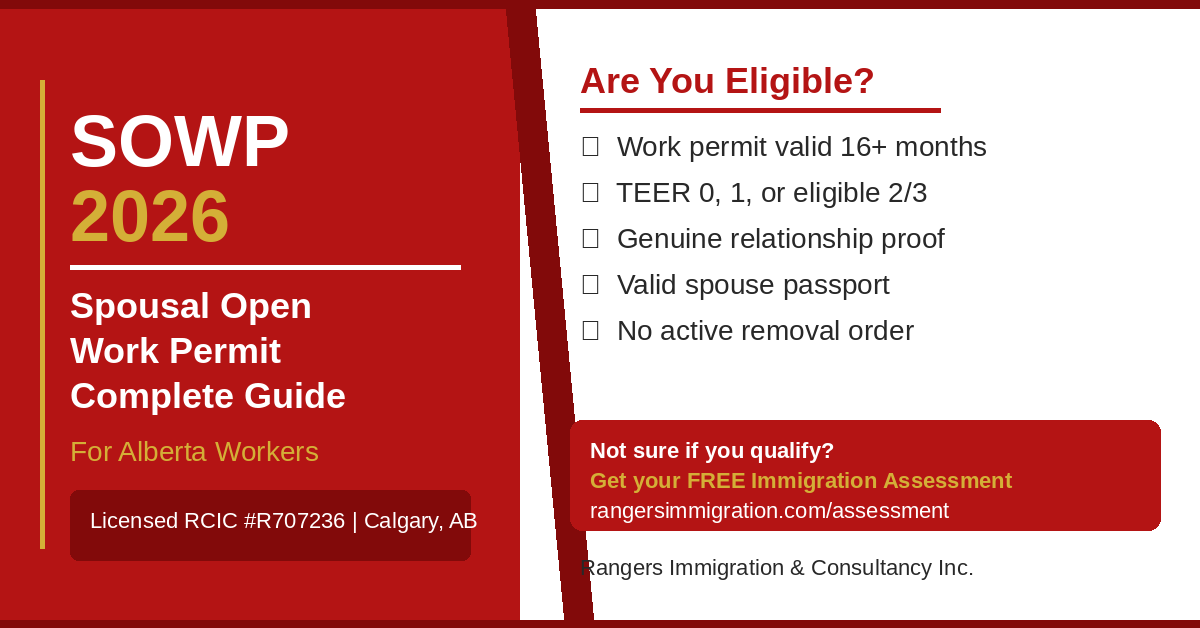
Spousal Open Work Permit (SOWP) Canada 2026 — Complete Guide for Alberta Workers
By Navjeet Kaur, RCIC #R707236 | Rangers Immigration & Consultancy Inc., Calgary AB
If you are a foreign worker in Alberta searching for information about the Spousal Open Work Permit 2026.
This guide answers every question my clients ask, based on verified IRCC policy as of 2026.
What Is a Spousal Open Work Permit (SOWP)?
A Spousal Open Work Permit is an open work permit issued to the spouse or common-law partner of a qualifying foreign worker, international student, or permanent residence applicant in Canada. Unlike a regular employer-specific work permit, an SOWP is not tied to a single employer. The holder can work for almost any employer, in almost any occupation, anywhere in Canada — giving your family the financial flexibility to build your life here together.
The January 21, 2025 Rule Change — What Actually Changed
Before January 21, 2025, most spouses of work permit holders — regardless of their occupation — qualified for an SOWP. That is no longer the case.
IRCC has fundamentally restricted eligibility. Today, whether your spouse qualifies depends entirely on your specific situation — your occupation type, your NOC/TEER level, and how much time remains on your work permit. The old rules no longer apply.
Important: Dependent children are no longer eligible for an open work permit under this measure as of January 21, 2025. If a child had a previously approved work permit, it remains valid until expiry, but new applications for dependent children are generally not accepted.
The 2026 Eligibility Rules for Spousal Open Work Permit
Your spouse’s eligibility for an SOWP depends entirely on your situation as the principal applicant. There are three main pathways.
Pathway 1 — If You Hold a Work Permit (Including LMIA-Based and LMIA-Exempt)
This applies to all foreign workers in Canada — whether your work permit is LMIA-supported, LMIA-exempt, or any other category.
Your spouse qualifies for an SOWP only if you meet all of the following:
Your occupation must be:
- TEER 0 (Management occupations), OR
- TEER 1 (Professional occupations requiring a university degree), OR
- A select TEER 2 or TEER 3 occupation in one of these specific sectors:
- Natural and applied sciences
- Construction trades
- Healthcare and medical occupations
- Natural resources and agriculture
- Education
- Sports and military
If you work in a TEER 4 or TEER 5 occupation — such as retail, food service, or general labour — your spouse is generally not eligible for an SOWP under current rules.
Your work permit must also be:
- Currently valid in Canada
- Valid for at least 16 months from the date IRCC receives your spouse’s SOWP application
This 16-month rule is critical and applies to every work permit category — LMIA-based, LMIA-exempt, and PGWP. If your work permit expires in less than 16 months, your spouse’s application will likely be refused regardless of your TEER level.
You must also:
- Not be subject to a removal order
- Not have made a refugee claim referred to the Immigration and Refugee Board
Pathway 2 — If You Hold a Post-Graduation Work Permit (PGWP)
A PGWP is treated as a work permit. The same rules above apply — your occupation must be TEER 0, TEER 1, or an eligible TEER 2/3 sector, and your PGWP must have at least 16 months of validity remaining when IRCC receives your spouse’s application.
An important note for PGWP holders: simply having a PGWP does not automatically make your spouse eligible. You must be actively employed in an eligible occupation at the time your spouse applies. If you are between jobs or working in a TEER 4/5 role, your spouse will not qualify under this pathway.
Pathway 3 — If You Are Sponsoring Your Spouse for Permanent Residence (Inland Spousal Sponsorship)
If your spouse is already in Canada and you have submitted an inland spousal sponsorship application, your spouse may be eligible for an SOWP under the PR sponsorship public policy. This pathway has different rules than the foreign worker pathways above — eligibility is based on the sponsorship application being actively in process, not on your occupation or TEER level.
There are specific timing and processing requirements for this pathway. Because the rules are nuanced and depend on your individual sponsorship file status, this is one of the situations where professional guidance before applying is strongly recommended.
Pathway 4 — Free Trade Agreement Workers (CUSMA, CETA, and Others)
Workers in Canada under free trade agreements such as CUSMA (formerly NAFTA) or CETA may have separate SOWP eligibility that is exempt from the TEER occupation restrictions above. If your work permit was issued under a free trade agreement, confirm your specific FTA category before assuming the general TEER rules apply to you.
SOWP Eligibility Checklist — Calgary 2026
Every application is unique, but these are the core documents required for most SOWP applications:
From You (the principal applicant in Canada):
- Copy of your valid work permit (both sides)
- Proof of employment — a current job offer letter or employment contract clearly showing your job title and NOC code
- Recent pay stubs (typically 2 to 3 months)
- Evidence confirming your TEER level (your NOC code and job description)
From Your Spouse (the SOWP applicant):
- Valid passport — must have sufficient validity beyond the expected permit duration
- Proof of your genuine relationship (see below — this is critical)
- Completed IRCC application forms
- Application fee: $255 CAD ($155 processing fee + $100 open work permit holder fee)
- Biometrics if required based on country of citizenship
Proof of Genuine Relationship — Do Not Underestimate This
The most common reason SOWP applications are refused — aside from ineligibility — is insufficient proof of a genuine relationship. IRCC officers must be satisfied that your relationship is real, ongoing, and not entered into for immigration purposes. Your relationship evidence package should include:
- Official marriage certificate or proof of common-law partnership
- Joint bank account statements or shared financial records
- Joint lease, mortgage, or utility bills
- Communication records — call logs, WhatsApp history, video call screenshots
- Photos together across different periods and locations
- Statutory declarations from family or friends who know you as a couple
- Any other evidence that shows a continuous, genuine relationship
The more comprehensive and consistent your relationship evidence, the stronger your application. Gaps in communication history or a lack of joint financial ties are red flags that IRCC officers will scrutinize.
How Long Will the Spousal Open Work Permit Be Issued For?
Your spouse’s SOWP will generally be issued for the same duration as your work permit, up to the expiry date of your spouse’s passport. IRCC cannot issue a work permit beyond the expiry of the holder’s passport.
Practical example: If your work permit is valid until March 2028 but your spouse’s passport expires in September 2026, the SOWP will only be issued until September 2026.
If your spouse’s passport is expiring within the next two years, renew it before applying.
Renewing an SOWP is not automatic. Your spouse must re-apply and still meet all eligibility requirements at the time of the renewal application.
How Long Does SOWP Processing Take?
Processing times change frequently and vary based on whether your spouse is applying from inside Canada (inland) or outside Canada (outland), whether biometrics are required, and IRCC’s current workload.
Always check current official processing times at canada.ca before planning your timeline. Do not rely on processing time estimates from social media, Facebook groups, or non-official websites — these are often outdated and can lead to poor planning decisions.
The Biggest Mistake People Make — And It Costs Them Dearly
In my practice, the most common and most preventable mistake is applying when the principal applicant is not eligible under the current TEER rules.
This happens because:
- The applicant found information online that was written before January 2025
- A non-regulated or ghost consultant told them they qualified without properly verifying their NOC code and TEER level
- The applicant assumed that having a Canadian job offer automatically qualifies their spouse
Before spending any money on application fees or document preparation, confirm your NOC code, your TEER level, and whether your specific occupation falls within the eligible categories. This single step — which takes less than 30 minutes with the right guidance — prevents the most expensive and damaging mistakes I see.
A refused application is not just a wasted fee. It creates a record that can complicate future applications and requires careful management.
Can Your Spouse Work While the SOWP Application Is Being Processed?
If your spouse is already in Canada and is applying to extend an existing SOWP before it expires, they can generally continue working under maintained status while awaiting a decision. This applies only if they apply before their current permit expires. Waiting until the permit expires removes this protection.
What Information Does Your Spouse Need From You?
Your spouse’s SOWP application is built around your status in Canada. They will need from you:
- A copy of your work permit (both sides)
- Your most recent employment letter confirming your job title, NOC code, and employment start date
- Your employer’s full business name and address
- Recent pay stubs confirming active employment
- Documentation confirming your current immigration status is valid and has at least 16 months remaining
The Strategic Value of SOWP Beyond Just Working
Many families focus only on the immediate benefit of your spouse being able to work. But there is a longer-term strategic advantage that is worth understanding.
If your spouse works in Canada on an SOWP in a skilled occupation, they begin accumulating Canadian work experience. That experience can significantly boost your family’s Express Entry CRS score through spousal points — potentially adding up to 40 points to your profile. It can also make your spouse independently eligible for Express Entry under the Canadian Experience Class in the future, giving your family two potential PR pathways instead of one.
This is why SOWP is not just a temporary fix for family separation. For many of my clients, it is the first strategic step in a long-term PR plan.
SOWP Eligibility Checklist
Use this checklist before submitting any SOWP application. If you cannot check every applicable box, your application may be at risk of refusal.
Your Status as the Principal Applicant:
- I currently hold a valid Canadian work permit
- My occupation is TEER 0, TEER 1, or an eligible TEER 2/3 sector occupation
- My work permit is valid for at least 16 months from today
- I am actively employed in my eligible occupation
- I am not subject to a removal order
- I have not made a refugee claim
Your Relationship Documentation:
- Valid marriage certificate or proof of common-law partnership
- Joint financial records (bank account, bills, lease, or mortgage)
- Communication history showing an ongoing relationship
- Photos together across different time periods and locations
- Statutory declaration from someone who knows us as a couple
Your Spouse’s Documents:
- Valid passport with sufficient validity remaining
- Passport valid beyond my work permit expiry date
- Biometrics completed or appointment scheduled (if required)
- Application fee of $255 CAD ready
Red Flags That Need Professional Review Before Applying:
- Previous SOWP, work permit, or visa refusal
- Gaps in relationship history or long periods of separation with limited documentation
- Recent change of employer or NOC code
- Uncertainty about your TEER level or NOC classification
- Work permit expiring within 16 months
If you checked everything in the first four sections, you may be ready to apply. If you flagged anything in the red flags section, get a professional review before submitting.
Why Work With a Regulated RCIC for Your SOWP Application?
Since the January 2025 rule changes, SOWP applications have become significantly more complex. I have helped clients navigate SOWP applications — including cases involving previous refusals — and the difference between a strong application and a weak one almost always comes down to preparation and eligibility assessment done before a single form is submitted.
As a regulated RCIC (License #R707236), I assess your eligibility before you spend a dollar on fees, identify the right NOC code for your occupation, build your relationship evidence package strategically, and ensure your application presents your case clearly to IRCC.
If you have previously received a refusal, that is not necessarily the end of the road. A well-prepared second application — with the right documentation and a clear understanding of why the first was refused — can succeed. But it requires a careful strategy, not just resubmitting the same package.
Ready to Find Out If You Qualify?
Every situation is different. The fastest way to know exactly where you stand is to have your specific case reviewed by a licensed professional before you apply.
Complete our free immigration assessment at rangersimmigration.com/assessment and I will personally review your situation and tell you your options — including whether you qualify, what documents you need, and what your realistic timeline looks like.
Rangers Immigration & Consultancy Inc. Navjeet Kaur | RCIC #R707236 Calgary, Alberta | Virtual & In-Person Consultations Available Across Canada Consultations available in English, ਪੰਜਾਬੀ & हिन्दी 📞 +1 587 221 1000
This article is for general informational purposes only and reflects IRCC policy as of March 2026. Immigration policy changes frequently. Always verify current requirements at canada.ca or consult a regulated immigration professional before making any application decisions. Reading this article does not create a consultant-client relationship.